Understanding the CGPA calculation formula is important for students who want to measure their overall academic performance. Whether you are studying at a college or university, knowing how CGPA works helps you track your progress, understand your grades, and plan your academic goals.
Many students know their semester GPA but are unsure how to calculate their cumulative grade point average. The calculation becomes simple when you understand three important terms: grade points, credit hours, and quality points.
In this guide, you will learn the standard CGPA formula, how to use it step by step, and how to calculate CGPA with practical examples.
What Is CGPA?
CGPA stands for Cumulative Grade Point Average. It represents a student’s overall academic performance across multiple semesters or academic terms.
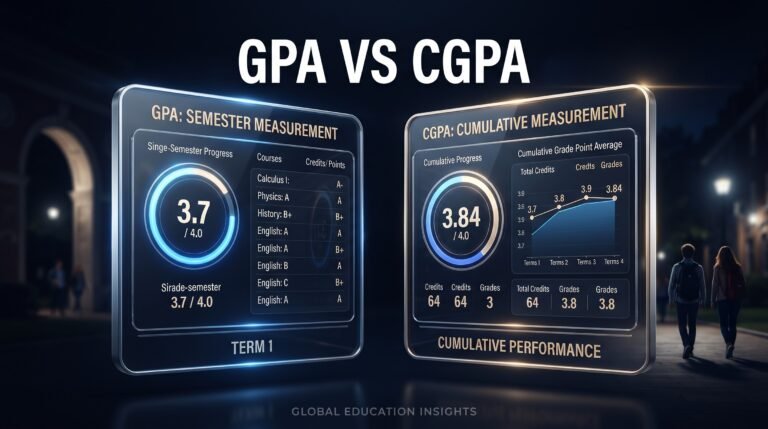
Unlike GPA, which generally measures performance during one semester, CGPA combines eligible academic results over a longer period.
For example, if a student completes four semesters, their CGPA provides an overall measurement of their performance across those semesters.
Universities commonly use CGPA for academic evaluations, scholarship eligibility, admission requirements, and graduation decisions.
What Is the CGPA Calculation Formula?
The standard formula used in many credit-hour-based grading systems is:
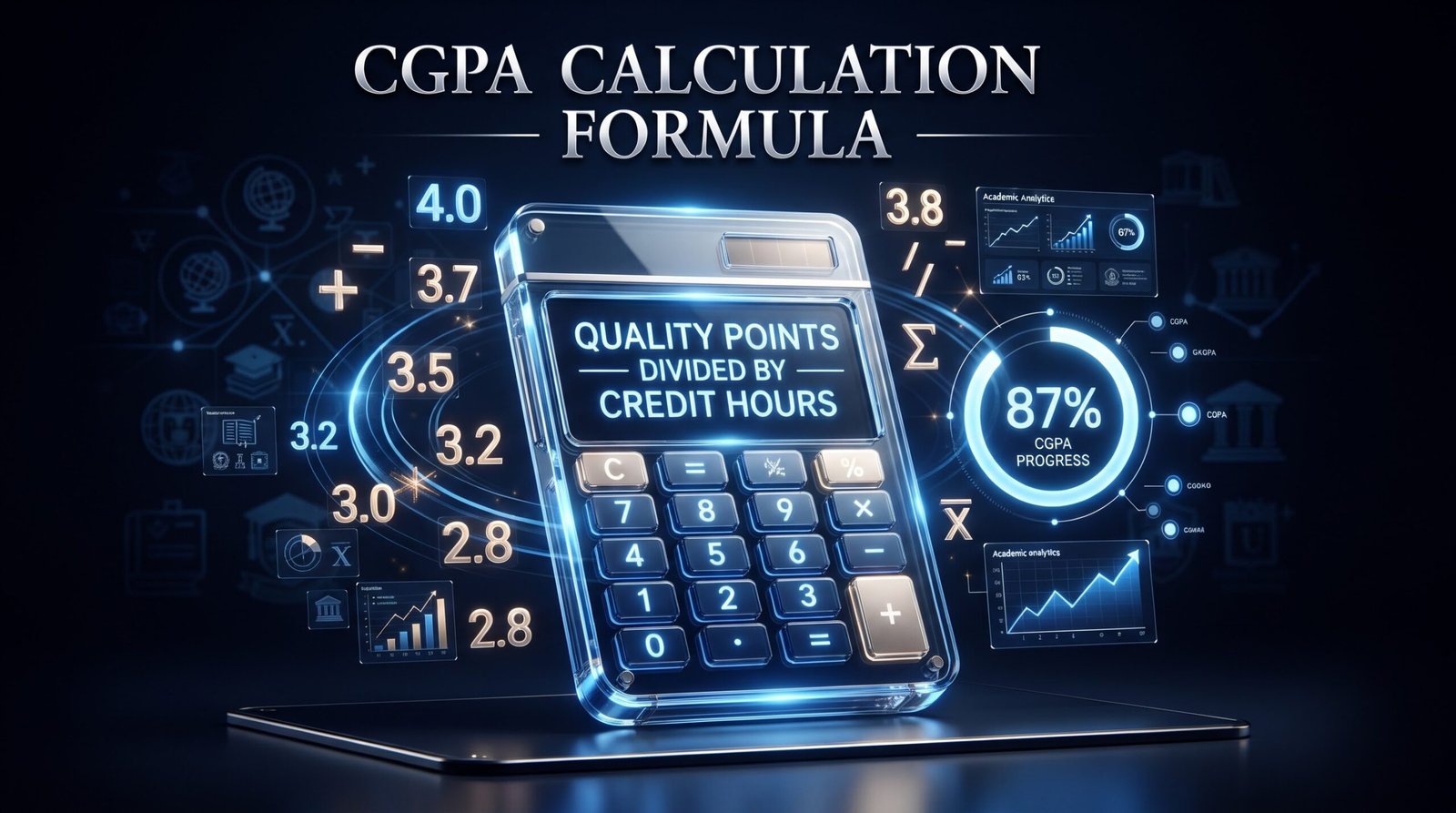
CGPA = Total Quality Points ÷ Total Credit Hours
To calculate quality points for a course, use:
Quality Points = Grade Points × Credit Hours
This means you first multiply the grade points earned in each course by its credit hours. Then, add all quality points and divide the result by the total credit hours.
The formula gives more weight to courses with higher credit hours.
Understanding the Terms Used in CGPA Calculation
Before using the formula, it is helpful to understand its main components.
| Term | Explanation |
|---|---|
| Grade Points | Numerical value assigned to a course grade |
| Credit Hours | Academic weight assigned to a course |
| Quality Points | Grade points multiplied by credit hours |
| Total Quality Points | Sum of quality points from included courses |
| Total Credit Hours | Sum of all included course credit hours |
| CGPA | Cumulative average calculated from quality points and credits |
Each university may use its own grade-point scale and rules for including courses in the calculation.
Step-by-Step CGPA Calculation
Follow these steps to calculate CGPA manually.
Step 1: Collect Your Grades
Check your transcript and identify the grade points earned in each course.
Step 2: Find Credit Hours
Write down the credit hours assigned to every course.
Step 3: Calculate Quality Points
Multiply the grade points of each course by its credit hours.
Step 4: Add Quality Points
Add all the quality points to calculate the total.
Step 5: Calculate Total Credit Hours
Add the credit hours of all courses included in your calculation.
Step 6: Apply the Formula
Divide total quality points by total credit hours. The result is your CGPA.
CGPA Calculation Example
Let’s calculate CGPA using a simple example.
Suppose a student completes five courses with the following results:
| Course | Grade Points | Credit Hours | Quality Points |
|---|---|---|---|
| English | 4.0 | 3 | 12.0 |
| Mathematics | 3.7 | 3 | 11.1 |
| Computer Science | 3.5 | 4 | 14.0 |
| Physics | 3.0 | 2 | 6.0 |
| Chemistry | 3.3 | 3 | 9.9 |
| Total | — | 15 | 53.0 |
Now apply the CGPA formula:
CGPA = Total Quality Points ÷ Total Credit Hours
CGPA = 53.0 ÷ 15
Final CGPA = 3.53
Therefore, the student’s CGPA is approximately 3.53 when rounded to two decimal places.
This example uses illustrative grade points. Your university may assign different numerical values to letter grades.
CGPA Formula for Multiple Semesters
If you want to calculate CGPA after completing several semesters, you can use semester GPA and credit-hour information.
The formula is:
CGPA = Σ (Semester GPA × Semester Credit Hours) ÷ Total Credit Hours
For example:
| Semester | GPA | Credit Hours | Quality Points |
|---|---|---|---|
| Semester 1 | 3.20 | 15 | 48.0 |
| Semester 2 | 3.50 | 18 | 63.0 |
| Semester 3 | 3.70 | 15 | 55.5 |
| Total | — | 48 | 166.5 |
Now divide total quality points by total credit hours:
CGPA = 166.5 ÷ 48
Final CGPA = 3.47
This weighted method is generally more accurate than simply averaging semester GPAs when credit hours are different.
Common CGPA Grading Scale
Many universities use a 4.0 grading scale, although grading systems differ between institutions.
The following table provides an illustrative example:
| Grade | Example Grade Points |
|---|---|
| A | 4.00 |
| A- | 3.70 |
| B+ | 3.30 |
| B | 3.00 |
| B- | 2.70 |
| C+ | 2.30 |
| C | 2.00 |
| D | 1.00 |
| F | 0.00 |
This is only an example. Actual grade-point values and letter-grade boundaries must be checked in your institution’s official grading policy.
Common Mistakes in CGPA Calculation
Students can make calculation errors if they do not understand how credit hours and grade points work.
Here are some common mistakes to avoid:
- Ignoring credit hours when calculating a weighted average.
- Using percentage marks directly as grade points without an approved conversion.
- Adding semester GPAs without considering different credit-hour totals.
- Including courses that are excluded under university rules.
- Ignoring repeated-course policies.
- Rounding numbers too early during calculations.
Always use your official transcript and institutional grading rules for the most accurate result.
Why Is the CGPA Formula Important?
The CGPA formula helps students understand their overall academic performance. It also makes it easier to evaluate progress across multiple semesters.
Universities may use CGPA to determine scholarship eligibility, academic standing, admission decisions, and graduation requirements.
Students can also use their CGPA to identify areas where they need improvement and set realistic academic targets for future semesters.
Frequently Asked Questions (FAQs)
1. What is the standard CGPA calculation formula?
The standard credit-hour-based formula is total quality points divided by total credit hours.
2. How do I calculate quality points?
Multiply the grade points earned in a course by the credit hours assigned to that course.
3. Can I calculate CGPA using semester GPA?
Yes. Multiply each semester GPA by its credit hours, add the results, and divide by total credit hours.
4. Is CGPA the average of all semester GPAs?
Only when all semesters have equal credit-hour weight. Otherwise, use the weighted CGPA formula.
5. How many decimal places should CGPA have?
Many institutions report CGPA to two decimal places, but rounding rules depend on the university.
6. Can CGPA be calculated without credit hours?
A simple average is possible if every course or semester has equal weight. For a weighted credit-hour system, credit hours are required.
Final Thoughts
The CGPA calculation formula is a useful way to measure overall academic performance. By multiplying grade points by credit hours, adding quality points, and dividing by total credit hours, students can calculate their cumulative academic average.
Understanding this formula makes it easier to track semester results, monitor academic progress, and prepare for future educational opportunities.
For quick calculations, you can also use an online CGPA calculator. Always follow your university’s official grading system to ensure accurate results.