GPA and CGPA are two important terms used in schools, colleges, and universities to measure students’ academic performance. Many students see these terms on their report cards and transcripts but do not fully understand how they are different.
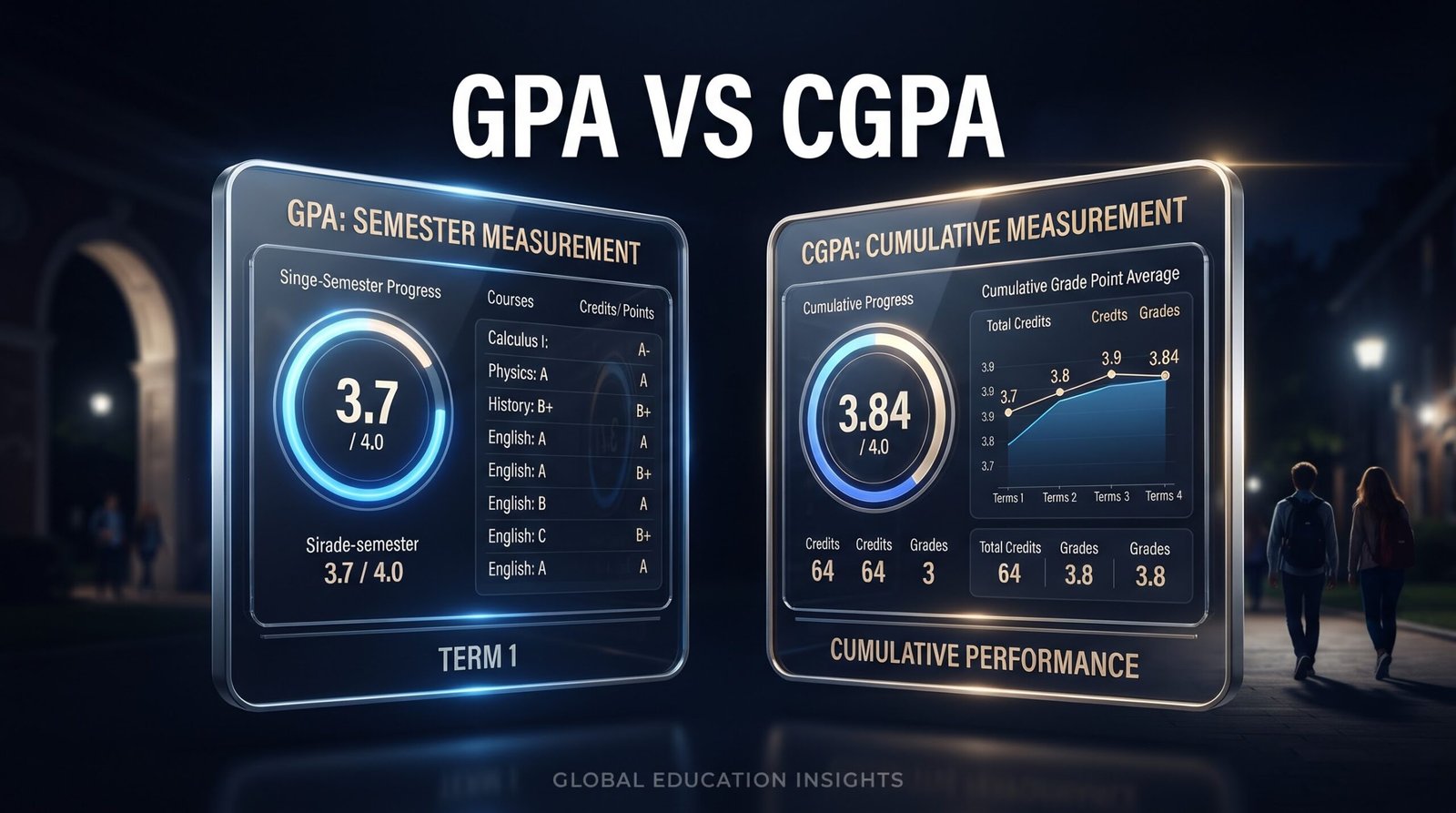
Although GPA and CGPA are closely related, they measure academic results over different periods. GPA generally represents performance during a single semester or academic term, while CGPA represents overall performance across multiple semesters.
Understanding the difference between GPA and CGPA can help students track their grades, evaluate academic progress, and prepare for university admissions, scholarships, and graduation requirements.
In this guide, we will explain both terms, compare their calculation methods, and provide simple examples.
What Is GPA?
GPA stands for Grade Point Average. It is a numerical measurement of a student’s academic performance during a particular semester, term, or academic period.
Universities assign grade points to letter grades or percentage ranges according to their grading policies. These grade points are used to calculate a student’s GPA.
For example, a student may receive a GPA of 3.5 in the first semester and 3.8 in the second semester. Each result represents performance during its respective semester.
GPA helps students understand how well they performed in their current academic term.
GPA Calculation Formula
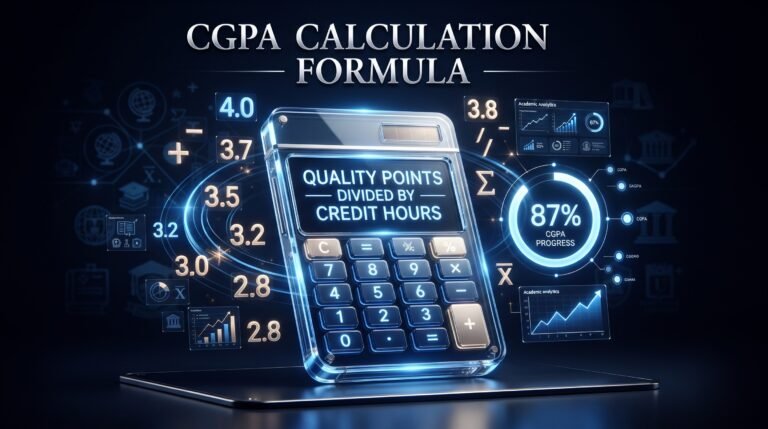
In a credit-hour-based grading system, GPA is calculated by dividing total quality points by total credit hours.
GPA = Total Quality Points ÷ Total Credit Hours
Quality points are calculated by multiplying course grade points by course credit hours.
Quality Points = Grade Points × Credit Hours
For example, if a student earns 3.5 grade points in a three-credit-hour course, the quality points are:
3.5 × 3 = 10.5
The same calculation is performed for all courses in the semester.
What Is CGPA?
CGPA stands for Cumulative Grade Point Average. It measures a student’s overall academic performance across multiple semesters or academic terms.
Unlike GPA, which usually covers one semester, CGPA combines eligible academic results over a longer period.
For example, if a student completes eight semesters in a bachelor’s degree program, their CGPA represents their combined academic performance across those semesters, according to the institution’s grading rules.
CGPA is commonly used for graduation eligibility, scholarship applications, university admissions, and academic evaluations.
CGPA Calculation Formula
The general formula for a credit-hour-based system is:
CGPA = Total Cumulative Quality Points ÷ Total Cumulative Credit Hours
This means students must combine the quality points and eligible credit hours from all included semesters.
For example, if a student has earned 180 quality points over 50 credit hours, the CGPA is:
180 ÷ 50 = 3.60
The result represents the student’s cumulative academic average.
Difference Between GPA and CGPA
The main difference between GPA and CGPA is the academic period they measure. GPA focuses on a particular semester, while CGPA measures combined performance across multiple semesters.
Here is a detailed comparison:
| Feature | GPA | CGPA |
|---|---|---|
| Full Form | Grade Point Average | Cumulative Grade Point Average |
| Meaning | Academic performance in a term | Overall academic performance |
| Time Period | Usually one semester | Multiple semesters |
| Calculation | Based on current term courses | Based on cumulative eligible results |
| Credit Hours | Semester credit hours | Combined credit hours |
| Purpose | Measures recent performance | Measures long-term performance |
| Academic Use | Semester evaluation | Graduation and overall evaluation |
| Changes | Changes with each new term | Changes as new results are included |
Both measurements are useful because they show different aspects of a student’s academic progress.
GPA vs CGPA Calculation Example
Let’s understand the difference with a practical example.
Suppose a student has completed three semesters with the following results:
| Semester | GPA | Credit Hours |
|---|---|---|
| Semester 1 | 3.20 | 15 |
| Semester 2 | 3.50 | 18 |
| Semester 3 | 3.80 | 15 |
The GPA for each semester is calculated separately. To find the overall CGPA, multiply each semester’s GPA by its credit hours.
Semester 1: 3.20 × 15 = 48
Semester 2: 3.50 × 18 = 63
Semester 3: 3.80 × 15 = 57
Now add the quality points:
48 + 63 + 57 = 168
Add all credit hours:
15 + 18 + 15 = 48
Finally, calculate CGPA:
168 ÷ 48 = 3.50
Therefore, the student’s cumulative GPA is 3.50.
This example shows that GPA measures individual semesters, while CGPA combines their results using credit-hour weighting.
Which Is More Important: GPA or CGPA?
Both GPA and CGPA are important, but their importance depends on the purpose for which academic performance is being evaluated.
GPA is useful for understanding recent academic performance. It helps students identify whether they are improving or struggling in a particular semester.
CGPA provides a broader picture of academic achievement. Universities may use it to determine graduation eligibility, academic standing, and scholarship requirements.
For example, a scholarship program may require a minimum CGPA, while a university department may review a student’s latest semester GPA to monitor academic progress.
Students should pay attention to both rather than focusing on only one measurement.
Can GPA and CGPA Be the Same?
Yes, GPA and CGPA can sometimes be the same.
For example, if a student has completed only one semester, their CGPA may be equal to their GPA because both represent the same academic results.
They can also be equal after multiple semesters if the weighted average of all included semesters happens to match the latest semester’s GPA.
However, this does not happen in every academic situation.
What Is a Good GPA and CGPA?
A good GPA or CGPA depends on the institution’s grading system and academic requirements.
In a commonly used 4.0 grading system, the following table provides a general interpretation:
| Grade Point Range | General Interpretation |
|---|---|
| 3.70–4.00 | Excellent |
| 3.30–3.69 | Very Good |
| 3.00–3.29 | Good |
| 2.50–2.99 | Average |
| 2.00–2.49 | Below Average |
| Below 2.00 | May be academically concerning |
These ranges are illustrative, not universal. Universities may use different grading scales and academic classifications.
Always check your institution’s official grading policy to understand your results correctly.
How Can Students Improve Their GPA and CGPA?
Students can improve their academic performance through consistent study habits and better preparation.
Here are some useful tips:
- Attend classes regularly and take clear notes.
- Prepare for examinations in advance.
- Complete assignments before deadlines.
- Focus on subjects where you receive lower grades.
- Ask instructors for help when necessary.
- Create a realistic weekly study schedule.
- Review your semester results and monitor your progress.
Improving semester GPA can gradually improve CGPA, although the impact depends on the number of credit hours already completed.
Frequently Asked Questions (FAQs)
1. What is the main difference between GPA and CGPA?
GPA usually measures academic performance during one semester, while CGPA represents cumulative performance across multiple semesters.
2. Is GPA better than CGPA?
Neither is universally better. GPA measures recent academic performance, while CGPA provides an overall view of academic achievement.
3. Can CGPA be lower than GPA?
Yes. If a student’s current semester GPA is higher than their previous cumulative average, their GPA can be greater than their CGPA.
4. Is CGPA calculated from all semesters?
Generally, CGPA combines eligible results from multiple semesters. However, repeated courses, transfer credits, and excluded subjects may be treated differently by each institution.
5. Does a high GPA increase CGPA?
Usually, yes. Earning a GPA higher than your existing CGPA can increase your cumulative average, depending on the credit hours involved.
6. Can GPA and CGPA be converted into percentages?
Some universities provide official conversion formulas, but there is no single universal conversion method. Students should follow their institution’s guidelines.
Final Thoughts
GPA and CGPA are both important academic measurements, but they serve different purposes. GPA shows how well a student performs during a particular semester, while CGPA provides an overall view of academic performance across multiple semesters.
Understanding their meanings, formulas, and calculation methods makes it easier to track academic progress and set realistic educational goals.
Students should monitor both GPA and CGPA throughout their studies and follow their university’s official grading policy for accurate results.