Understanding how to convert GPA into CGPA is important for students who want to track their academic performance across multiple semesters. GPA and CGPA are closely related, but they represent academic results over different periods.
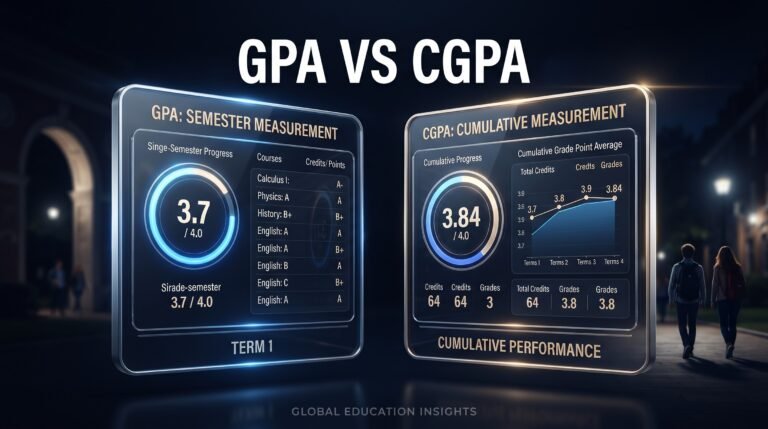
GPA usually measures performance during one semester, while CGPA represents the combined performance of multiple semesters. Students often need to calculate their CGPA when applying for scholarships, checking graduation eligibility, or reviewing their overall academic progress.
The good news is that converting GPA into CGPA is straightforward when you know your semester results and credit hours.
In this guide, you will learn how to convert GPA into CGPA using simple formulas, practical examples, and step-by-step instructions.
What Is GPA?
GPA stands for Grade Point Average. It measures a student’s academic performance during a particular semester or academic term.
Universities assign numerical grade points to students according to their examination results and grading policies.
For example, a student might receive a GPA of 3.2 in the first semester and 3.7 in the second semester.
Each GPA represents performance during its respective semester.
What Is CGPA?
CGPA stands for Cumulative Grade Point Average. It represents a student’s overall academic performance across multiple semesters.
Unlike GPA, which generally covers one semester, CGPA combines eligible academic results from previous and current semesters.
For example, if a student completes six semesters, their CGPA provides a cumulative measurement of their academic performance across those semesters.
Can You Convert GPA into CGPA?
Yes, you can calculate CGPA using your semester GPA results. However, a single semester GPA is not enough to determine your cumulative CGPA unless you have completed only one semester.
To calculate CGPA accurately, you generally need:
- GPA for each completed semester.
- Credit hours for each semester.
- Total eligible credit hours.
- Your university’s grading and academic calculation rules.
If all semesters have equal credit hours, you can calculate a simple average of their GPAs. If credit hours differ, you should use a weighted average.
Formula to Convert GPA into CGPA
The standard formula for a credit-hour-based grading system is:
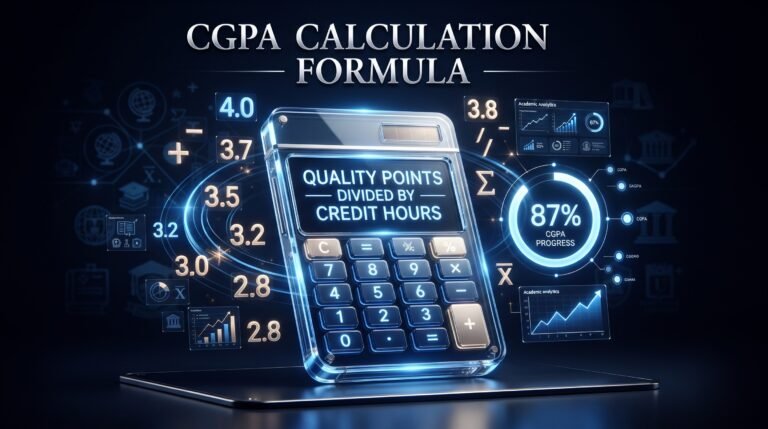
CGPA = Total Semester Quality Points ÷ Total Credit Hours
You can also calculate it using semester GPA results:
CGPA = Σ (Semester GPA × Semester Credit Hours) ÷ Total Credit Hours
Here, the symbol Σ means adding all the semester quality-point totals together.
This formula gives more weight to semesters with more credit hours.
How to Convert GPA into CGPA Step by Step
Follow these simple steps to calculate your cumulative GPA.
Step 1: Collect Your Semester GPAs
Write down the GPA earned in every completed semester.
Step 2: Find Semester Credit Hours
Check how many credit hours you completed in each semester.
Step 3: Multiply GPA by Credit Hours
Multiply each semester GPA by its credit hours to calculate semester quality points.
Step 4: Add All Quality Points
Combine the quality points from all included semesters.
Step 5: Add Total Credit Hours
Calculate the total credit hours across those semesters.
Step 6: Divide the Totals
Divide total quality points by total credit hours to find your CGPA.
Example 1: Convert GPA into CGPA with Equal Credit Hours
Suppose a student has completed three semesters. Each semester has 15 credit hours.
| Semester | GPA | Credit Hours |
|---|---|---|
| Semester 1 | 3.00 | 15 |
| Semester 2 | 3.50 | 15 |
| Semester 3 | 3.80 | 15 |
Because all semesters have equal credit hours, you can calculate the average GPA:
CGPA = (3.00 + 3.50 + 3.80) ÷ 3
CGPA = 10.30 ÷ 3
Final CGPA = 3.43
This method works because every semester has the same credit-hour weight.
Example 2: Convert GPA into CGPA with Different Credit Hours
Now suppose a student has completed three semesters with different credit hours.
| Semester | GPA | Credit Hours | Quality Points |
|---|---|---|---|
| Semester 1 | 3.20 | 15 | 48.00 |
| Semester 2 | 3.50 | 18 | 63.00 |
| Semester 3 | 3.80 | 12 | 45.60 |
| Total | — | 45 | 156.60 |
Now apply the formula:
CGPA = 156.60 ÷ 45
Final CGPA = 3.48
This example shows why credit hours are important. Simply averaging semester GPAs would produce a different and potentially incorrect result.
What Happens If You Have Only One Semester GPA?
If you have completed only one semester, your CGPA will generally be the same as your GPA, provided both use the same grading rules and include the same courses.
For example:
| Academic Result | Value |
|---|---|
| Semester GPA | 3.60 |
| Total Semesters | 1 |
| CGPA | 3.60 |
Once you complete additional semesters, your CGPA will be calculated using the results and eligible credit hours from all included semesters.
Common Mistakes When Converting GPA into CGPA
Students sometimes make mistakes when calculating their cumulative academic results.
Here are some common errors to avoid:
- Ignoring credit hours: Different semester credit totals require weighted calculations.
- Using only the latest GPA: CGPA normally includes previous eligible academic results.
- Mixing grading systems: Results from different grading scales may require an official conversion method.
- Incorrect rounding: Follow your university’s rounding rules.
- Ignoring repeated courses: Universities may have different policies for replacing or including repeated-course grades.
Always check your academic transcript and institution’s grading policy before calculating your final result.
Why Is Converting GPA into CGPA Important?
Knowing your CGPA helps you understand your overall academic standing.
Universities may use CGPA to evaluate graduation eligibility, scholarships, academic awards, and admission applications.
It also helps students identify whether their academic performance is improving over time.
For example, a student with a lower CGPA can work toward earning higher semester GPAs to improve their cumulative average in future semesters.
Frequently Asked Questions (FAQs)
1. How do I convert GPA into CGPA?
Multiply each semester GPA by its credit hours, add the quality points, and divide by the total credit hours.
2. Can I convert one GPA into CGPA?
If you have completed only one semester, your GPA and CGPA are generally the same. If you have multiple semesters, you need their eligible results to calculate cumulative performance.
3. Is CGPA the average of all semester GPAs?
It can be a simple average when all semesters have equal credit hours. When credit hours differ, a weighted average is generally required.
4. Can GPA be higher than CGPA?
Yes. A student can earn a high GPA in the latest semester while having a lower CGPA because of previous academic results.
5. Does a higher semester GPA increase CGPA?
Usually, yes. If your new semester GPA is higher than your existing CGPA, it will generally increase your cumulative average, assuming the results are included under the same grading rules.
6. Can I calculate CGPA without credit hours?
You can calculate a simple average if all semesters have equal weight. However, accurate weighted CGPA calculations require credit-hour information.
Final Thoughts
Converting GPA into CGPA is a simple process when you understand the relationship between semester results and credit hours.
The most reliable method is to multiply each semester GPA by its credit hours, add all quality points, and divide by total credit hours.
By using the correct formula and checking your university’s grading rules, you can calculate your cumulative academic performance and monitor your progress throughout your educational journey.