Calculating CGPA is an important part of understanding your academic performance. Whether you are studying at a college, university, or another educational institution, knowing how to calculate your Cumulative Grade Point Average helps you track your progress throughout your academic program.
Many students know their semester GPA but do not understand how to combine results from multiple semesters to find their overall CGPA. The calculation becomes easier when you understand grade points, credit hours, and quality points.
In this guide, you will learn how to calculate CGPA using a simple formula, understand the role of credit hours, and follow practical examples. You will also learn how to calculate CGPA from semester results.
What Is CGPA?
CGPA stands for Cumulative Grade Point Average. It represents a student’s overall academic performance across multiple semesters or academic terms.
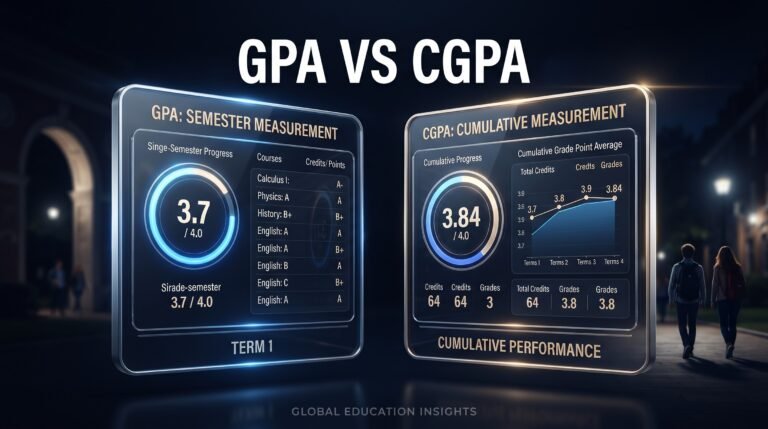
Unlike GPA, which generally measures performance during one semester, CGPA combines eligible academic results over a longer period.
For example, if you have completed six semesters of a degree program, your CGPA represents your combined academic performance across those semesters, according to your institution’s grading rules.
CGPA is commonly used for university admissions, scholarships, academic evaluations, and graduation requirements.
What Is the Formula to Calculate CGPA?
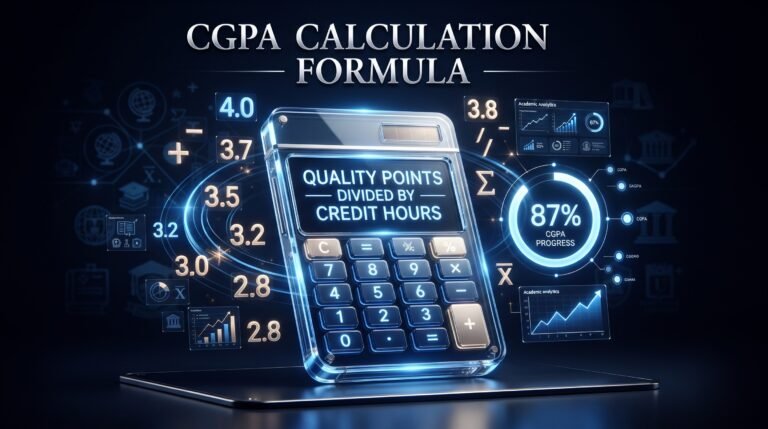
The most common method of calculating CGPA in a credit-hour-based grading system is to divide total quality points by total credit hours.
CGPA = Total Quality Points ÷ Total Credit Hours
To calculate quality points for an individual course, use this formula:
Quality Points = Grade Points × Course Credit Hours
Here is what each term means:
| Term | Meaning |
|---|---|
| Grade Points | Numerical value assigned to your course grade |
| Credit Hours | Academic weight assigned to a course |
| Quality Points | Grade points multiplied by credit hours |
| CGPA | Overall average based on total quality points and credits |
This weighted calculation gives courses with more credit hours a greater effect on the final result.
How to Calculate CGPA Step by Step
You can calculate CGPA manually by following these simple steps.
Step 1: Collect Your Course Grades
First, collect your grades or grade points for all the courses included in your calculation. Your university’s transcript usually contains this information.
Step 2: Find the Credit Hours
Check the credit hours assigned to each course. For example, one course may have three credit hours, while another may have four.
Step 3: Calculate Quality Points
Multiply the grade points of each course by its credit hours.
For example:
3.7 × 3 = 11.1 quality points.
Repeat this calculation for every course.
Step 4: Add All Quality Points
After calculating quality points for each course, add them together to find the total quality points.
Step 5: Add Total Credit Hours
Calculate the sum of the credit hours for all included courses.
Step 6: Divide to Find CGPA
Finally, divide total quality points by total credit hours.
The result is your CGPA, usually rounded according to your institution’s rules.
CGPA Calculation Example
Let’s understand the formula with a practical example.
Suppose a student has completed five courses with the following grades and credit hours:
| Course | Grade Points | Credit Hours | Quality Points |
|---|---|---|---|
| English | 4.0 | 3 | 12.0 |
| Mathematics | 3.7 | 3 | 11.1 |
| Computer Science | 3.3 | 4 | 13.2 |
| Physics | 3.0 | 2 | 6.0 |
| Total | — | 12 | 42.3 |
Now apply the CGPA formula.
Total Quality Points = 42.3
Total Credit Hours = 12
CGPA = 42.3 ÷ 12
CGPA = 3.525
Therefore, the student’s CGPA is approximately 3.53, if rounded to two decimal places.
This example uses an illustrative grading scale. Actual grade-point values depend on the university.
How to Calculate CGPA From Semester GPA
If you already know your semester GPA and credit hours, you can calculate your cumulative CGPA without calculating every course again, provided the semester results use the same grading system and the figures represent the eligible credits.
Use this formula:
CGPA = Sum of (Semester GPA × Semester Credit Hours) ÷ Total Credit Hours
For example, suppose a student has the following semester results:
| Semester | GPA | Credit Hours | Quality Points |
|---|---|---|---|
| Semester 1 | 3.20 | 15 | 48.0 |
| Semester 2 | 3.50 | 18 | 63.0 |
| Semester 3 | 3.70 | 15 | 55.5 |
| Total | — | 48 | 166.5 |
Now divide total quality points by total credit hours:
CGPA = 166.5 ÷ 48
Final CGPA = 3.47
This method is useful for students who want to calculate their overall academic performance after completing several semesters.
Why Are Credit Hours Important in CGPA Calculation?
Credit hours determine how much each course contributes to your overall academic result.
For example, imagine you receive a grade point of 4.0 in a two-credit-hour course and 3.0 in a four-credit-hour course.
| Course | Grade Points | Credit Hours | Quality Points |
|---|---|---|---|
| Course A | 4.0 | 2 | 8.0 |
| Course B | 3.0 | 4 | 12.0 |
| Total | — | 6 | 20.0 |
Your CGPA would be:
20 ÷ 6 = 3.33
This shows why simply adding grade points and dividing by the number of courses may produce an incorrect result. Credit hours must be considered in a weighted grading system.
What Is the Difference Between GPA and CGPA Calculation?
GPA and CGPA use similar calculation principles, but they cover different academic periods.
| Feature | GPA | CGPA |
|---|---|---|
| Full Form | Grade Point Average | Cumulative Grade Point Average |
| Calculation Period | Usually one semester | Multiple semesters |
| Academic Coverage | Current term | Overall eligible academic record |
| Credit Hours | Current semester credits | Combined eligible credits |
| Purpose | Measures semester performance | Measures cumulative performance |
For example, if your GPA is 3.8 in the current semester, it does not automatically mean your CGPA is also 3.8. Your previous semester results also affect your cumulative average.
Common Mistakes to Avoid When Calculating CGPA
Students sometimes make small mistakes that lead to incorrect results. Keep these points in mind:
- Ignoring credit hours: Always consider course credit hours when using a weighted CGPA formula.
- Using the wrong grade points: Check your institution’s official grading scale.
- Mixing different grading systems: Do not combine results from different scales without an approved conversion method.
- Incorrect rounding: Follow your university’s rules for decimal places.
- Ignoring repeated-course policies: Some institutions replace previous grades, while others include both attempts or follow different rules.
- Including excluded courses: Failed, withdrawn, transferred, or non-credit courses may be treated differently depending on institutional policy.
Checking your transcript and academic regulations can help prevent these errors.
How Can You Calculate CGPA Easily?
If you do not want to calculate everything manually, you can use an online CGPA calculator.
A CGPA calculator can make the process faster by allowing you to enter your grade points and credit hours. The tool then applies the calculation formula and displays the result.
Before using any calculator, make sure it supports your institution’s grading scale and calculation rules.
You can also use a GPA calculator to calculate individual semester results before working out your cumulative average.
Frequently Asked Questions (FAQs)
1. What is the easiest way to calculate CGPA?
The easiest way is to multiply each course’s grade points by its credit hours, add all quality points, and divide the total by all included credit hours.
2. Can I calculate CGPA using semester GPA?
Yes. Multiply each semester GPA by its corresponding eligible credit hours. Add the results and divide by the total credit hours.
3. Is CGPA calculated by adding all GPAs?
Not usually. Simply adding semester GPAs and dividing by the number of semesters can give an incorrect result when semesters have different credit hours. A weighted calculation is generally more accurate.
4. Can CGPA be calculated without credit hours?
Some institutions use different grading methods, but in a credit-hour-based system, credit hours are needed for an accurate weighted calculation.
5. How many decimal places should CGPA have?
Many institutions display CGPA to two decimal places, but rounding and reporting rules vary. Always follow your university’s official policy.
6. Can I improve my CGPA in the next semester?
Yes. Achieving higher grades in upcoming courses can increase your cumulative average, although the amount of improvement depends on your existing CGPA and completed credit hours.
Final Thoughts
Learning how to calculate CGPA makes it easier to understand your academic progress and plan your educational goals. The main formula is straightforward: divide total quality points by total credit hours.
By understanding grade points, credit hours, and semester results, you can calculate your cumulative academic performance accurately. For quick results, consider using an online CGPA calculator and always follow your university’s official grading rules.