CGPA is an important academic measurement used by schools, colleges, and universities to evaluate a student’s overall academic performance. Whether you are applying for higher education, checking your academic progress, or preparing for a scholarship, understanding CGPA can help you make better educational decisions.
Many students hear the terms GPA and CGPA but are not always sure how they differ. Although both are related to academic grades, they represent different aspects of a student’s performance.
In this guide, you will learn what CGPA means, how it is calculated, which formula is used, and how it differs from GPA. We will also explain practical examples to make the calculation easier.
What Is CGPA?
CGPA stands for Cumulative Grade Point Average. It represents the average academic performance of a student across multiple semesters or academic terms.
Unlike semester GPA, which measures performance during one particular semester, CGPA considers results from several semesters combined.
For example, if a student completes four semesters, their CGPA provides an overall picture of their academic performance across those semesters, based on the institution’s grading rules.
CGPA is commonly used by educational institutions to evaluate students for graduation, scholarships, admissions, and academic recognition.
What Does CGPA Mean?
The word Cumulative means something collected or combined over time. Grade Point represents the numerical value assigned to a letter grade, while Average refers to the calculated result.
Together, Cumulative Grade Point Average describes the average of a student’s grade points over a specified academic period.
For example, a student may achieve a GPA of 3.2 in the first semester, 3.5 in the second semester, and 3.7 in the third semester. Their CGPA combines the academic results of all three semesters, taking the applicable credit hours into account.
This gives students and universities a broader understanding of academic progress.
How Is CGPA Calculated?
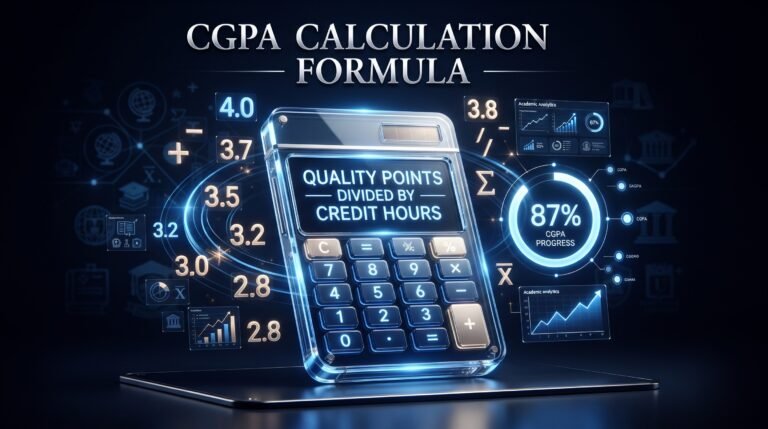
CGPA is generally calculated by dividing the total quality points earned by the total credit hours attempted.
The standard formula for a credit-hour-based grading system is:
CGPA = Total Quality Points ÷ Total Credit Hours
Quality points are calculated by multiplying the grade points earned in a course by the credit hours assigned to that course.
Quality Points = Grade Points × Credit Hours
To calculate CGPA accurately, you usually need the grade points and credit hours for all included courses across the relevant semesters.
Example of CGPA Calculation
Suppose a student has completed three semesters with the following results:
| Semester | GPA | Credit Hours |
|---|---|---|
| Semester 1 | 3.20 | 15 |
| Semester 2 | 3.50 | 18 |
| Semester 3 | 3.70 | 15 |
First, multiply each semester’s GPA by its credit hours:
- Semester 1: 3.20 × 15 = 48
- Semester 2: 3.50 × 18 = 63
- Semester 3: 3.70 × 15 = 55.5
Now add the quality points:
48 + 63 + 55.5 = 166.5
Add the total credit hours:
15 + 18 + 15 = 48
Finally, divide total quality points by total credit hours:
CGPA = 166.5 ÷ 48 = 3.47
Therefore, the student’s cumulative GPA is approximately 3.47.
This example assumes all semesters use the same grading system and that the listed credit hours and GPA figures are eligible for inclusion in the cumulative calculation.
Difference Between GPA and CGPA
GPA and CGPA are both academic performance indicators, but they measure performance over different periods.
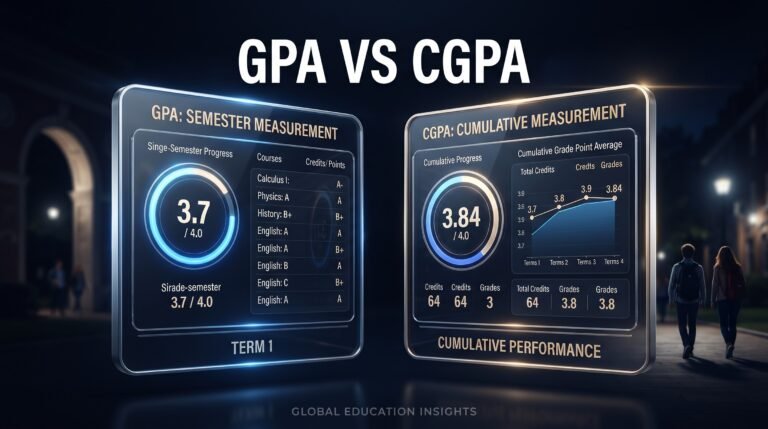
GPA usually represents a student’s academic performance during one semester or term. CGPA represents the combined performance across multiple semesters or terms.
Here is a simple comparison:
| Feature | GPA | CGPA |
|---|---|---|
| Full Form | Grade Point Average | Cumulative Grade Point Average |
| Measurement | One semester or term | Multiple semesters |
| Purpose | Measures short-term performance | Measures overall academic performance |
| Calculation | Based on one term’s courses | Based on cumulative results |
| Academic Use | Semester evaluation | Overall academic evaluation |
For example, a student might have a GPA of 3.8 in the current semester but a CGPA of 3.4 because of lower grades in previous semesters.
This is why both measurements are useful when evaluating academic performance.
What Is a Good CGPA?
A good CGPA depends on the university, grading system, academic program, and requirements of the institution.
In a common 4.0 grading system, students often use the following general interpretation:
| CGPA | General Academic Interpretation |
|---|---|
| 3.70–4.00 | Excellent |
| 3.30–3.69 | Very Good |
| 3.00–3.29 | Good |
| 2.50–2.99 | Average |
| 2.00–2.49 | Below Average |
| Below 2.00 | May be academically concerning |
These ranges are illustrative rather than universal. Different universities may use different grading scales, academic standing rules, and minimum graduation requirements.
Students should always check their institution’s official grading policy before interpreting their CGPA.
Why Is CGPA Important?
CGPA plays an important role in academic life because it provides a summary of a student’s performance over time.
1. University Admissions
Many universities consider CGPA when evaluating applications for undergraduate, postgraduate, and other academic programs.
2. Scholarships
Some scholarship programs require students to maintain a minimum CGPA to qualify or continue receiving financial support.
3. Job Opportunities
Certain employers consider academic performance when reviewing applications, particularly for fresh graduates and entry-level positions.
4. Academic Progress
CGPA helps students understand their overall performance and identify whether they are improving or need to work harder.
5. Graduation Requirements
Many educational institutions require students to achieve a minimum CGPA to complete their degree successfully.
How Can You Improve Your CGPA?
Improving CGPA requires consistent academic effort and good study habits. Students should focus on improving their performance in upcoming semesters.
Here are some practical tips:
- Attend classes regularly and participate in academic activities.
- Complete assignments and projects before their deadlines.
- Prepare for examinations using a realistic study schedule.
- Identify difficult subjects and spend additional time understanding them.
- Ask teachers for help when a topic is unclear.
- Review previous examination papers to understand question patterns.
- Monitor semester results and calculate your academic progress.
Even small improvements in individual courses can make a positive difference to your overall CGPA over time.
Frequently Asked Questions (FAQs)
1. What is the full form of CGPA?
CGPA stands for Cumulative Grade Point Average. It measures a student’s overall academic performance across multiple semesters or academic terms.
2. Is CGPA the same as GPA?
No. GPA generally measures academic performance during one semester, while CGPA combines academic performance across multiple semesters.
3. How do I calculate my CGPA?
Divide the total quality points earned by the total credit hours included in the calculation. The exact method may vary according to your university’s academic policy.
4. Is a 3.5 CGPA good?
On a common 4.0 grading scale, a 3.5 CGPA is generally considered a strong academic result. However, the interpretation depends on the institution and program.
5. Can CGPA decrease?
Yes. If a student’s performance in a new semester is lower than their existing CGPA, the cumulative average may decrease.
6. Can I convert CGPA into a percentage?
Some institutions provide an official CGPA-to-percentage conversion formula. However, there is no single universal conversion method. Students should use the formula provided by their institution.
Final Thoughts
CGPA is an important measurement of overall academic performance. It helps students, universities, and employers understand how consistently a student has performed throughout an academic program.
Understanding the CGPA formula, calculation method, and difference between GPA and CGPA makes it easier to monitor academic progress and set realistic educational goals.
If you want to calculate your academic results quickly, use a reliable GPA or CGPA calculator and always check your university’s grading policy for accurate results.