Understanding the GPA calculation formula is essential for students who want to measure their academic performance accurately. Whether you are studying at a high school, college, or university, knowing how GPA works can help you understand your grades and monitor your educational progress.
GPA stands for Grade Point Average. It is a numerical representation of academic performance based on the grades earned in different courses. Educational institutions use GPA to evaluate students, determine academic standing, and sometimes establish eligibility for scholarships and other academic opportunities.
Although GPA calculations may look complicated at first, the basic formula is relatively simple. Once you understand grade points, credit hours, and quality points, you can calculate your GPA using a straightforward mathematical process.
In this guide, you will learn the standard GPA calculation formula, understand how it works, explore practical examples, and discover how different grading systems affect your results.
What Is the GPA Calculation Formula?
The GPA calculation formula is a mathematical method used to determine the average grade points earned by a student across multiple courses.
Most colleges and universities use a credit-weighted formula. This means each course contributes to the final GPA according to its assigned credit hours.
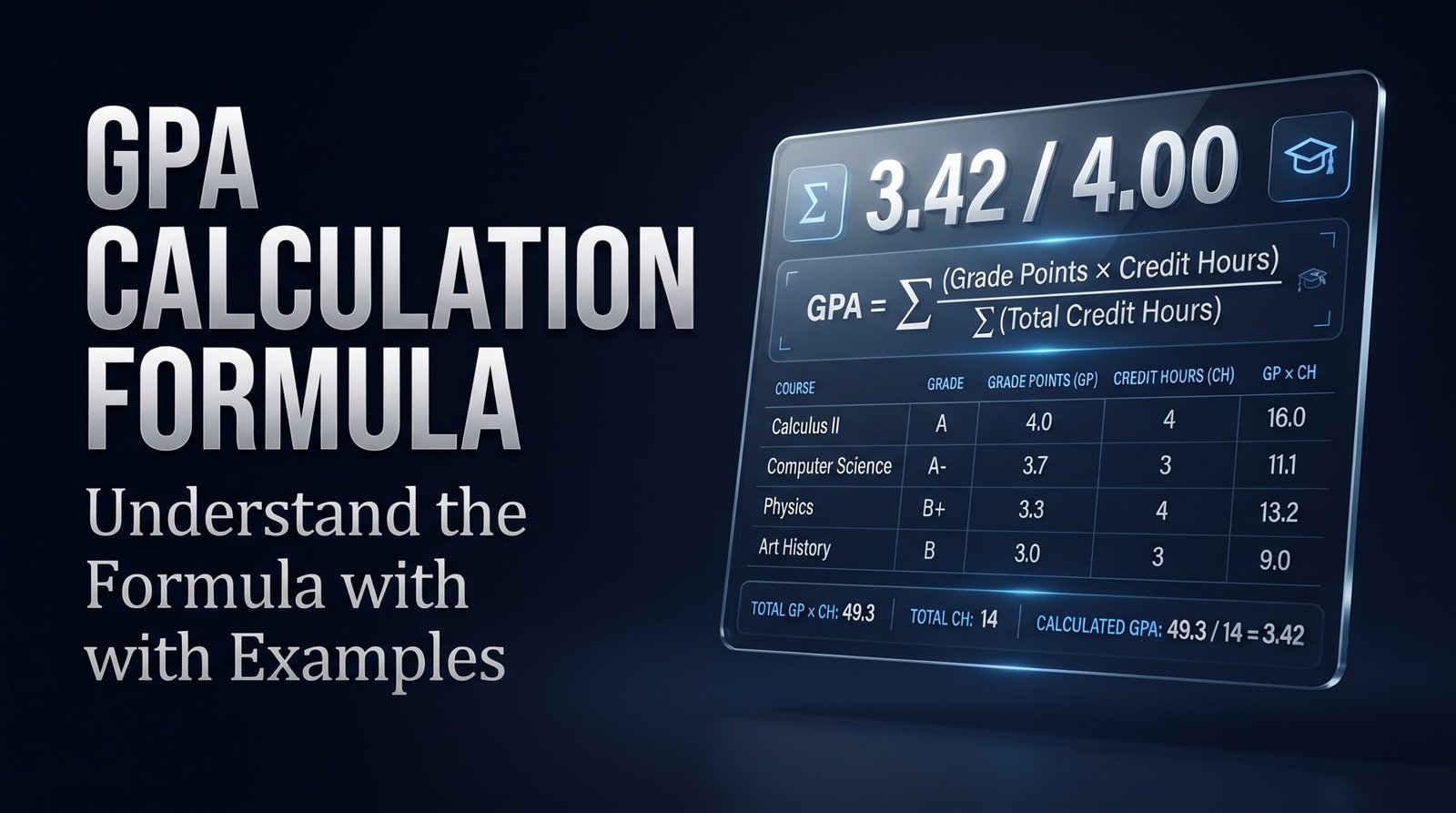
The standard formula is:
GPA = Total Quality Points ÷ Total Credit Hours
Quality points are calculated by multiplying the grade points earned in a course by the course’s credit hours.
The complete mathematical formula is:
GPA = Σ (Grade Points × Credit Hours) ÷ Σ Credit Hours
This formula provides a weighted average of your academic performance.
For example, a course worth four credit hours generally has a greater impact on GPA than a course worth only two credit hours.
Understanding the Important Terms
Before applying the GPA formula, it is important to understand three basic terms.
1. Grade Points
Grade points are numerical values assigned to letter grades or other academic results.
For example, a common 4.0 grading scale assigns 4.0 points to an A, 3.0 points to a B, and 2.0 points to a C.
2. Credit Hours
Credit hours represent the academic weight assigned to a particular course.
A university may assign different credit hours depending on the course workload, structure, and academic requirements.
3. Quality Points
Quality points represent the weighted value of a course.
They are calculated by multiplying the course’s grade points by its credit hours.
For example:
3.5 grade points × 3 credit hours = 10.5 quality points.
These three elements are used together to calculate a credit-weighted GPA.
Common 4.0 GPA Grading Scale
Many educational institutions use a 4.0 grading system to convert academic grades into numerical points.
The following table shows a simplified example:
| Letter Grade | Grade Points | Performance |
|---|---|---|
| A | 4.0 | Excellent |
| B | 3.0 | Good |
| C | 2.0 | Average |
| D | 1.0 | Below Average |
| F | 0.0 | Fail |
Some universities also use plus and minus grades, such as A-, B+, and C-. Their numerical values depend on the institution’s grading policy.
Always check your official grading scale before calculating your GPA.
How to Apply the GPA Calculation Formula
You can calculate your GPA by following these six steps.
Step 1: List Your Courses
Write down all the courses included in your GPA calculation.
Make sure you use the eligible courses and final grades recorded by your institution.
Step 2: Find the Grade Points
Convert each course grade into its corresponding numerical value using your institution’s grading scale.
Step 3: Identify Credit Hours
Find the number of credit hours assigned to each course.
Step 4: Calculate Quality Points
Multiply the grade points of each course by its credit hours.
Step 5: Calculate the Totals
Add all quality points together. Then calculate the total credit hours.
Step 6: Apply the Formula
Divide the total quality points by the total credit hours.
The result is your GPA.
GPA Calculation Formula Example
Let’s consider a student who has completed four university courses.
The student’s grades and credit hours are shown below:
| Subject | Grade | Grade Points | Credit Hours |
|---|---|---|---|
| Mathematics | A | 4.0 | 3 |
| English | B | 3.0 | 3 |
| Computer Science | A | 4.0 | 4 |
| Physics | C | 2.0 | 2 |
| Total | — | — | 12 |
Now calculate the quality points for each course:
- Mathematics: 4.0 × 3 = 12
- English: 3.0 × 3 = 9
- Computer Science: 4.0 × 4 = 16
- Physics: 2.0 × 2 = 4
Add the quality points:
12 + 9 + 16 + 4 = 41
The total credit hours are 12.
Apply the GPA calculation formula:
41 ÷ 12 = 3.4167
Final GPA = 3.42 out of 4.00
This example demonstrates how grade points and credit hours work together to determine the final academic average.
Simple GPA Formula Without Credit Hours
Some schools use a simple average of grade points rather than a credit-weighted calculation.
In this method, every subject is treated equally.
The formula is:
GPA = Total Grade Points ÷ Number of Courses
For example, suppose a student receives these grade points:
| Subject | Grade Points |
|---|---|
| Mathematics | 4.0 |
| English | 3.0 |
| Science | 3.0 |
| History | 2.0 |
| Total | 12.0 |
Divide the total grade points by the number of subjects:
12 ÷ 4 = 3.00
The student’s GPA is 3.00.
This method is appropriate only when the institution uses an equal-weight grading system.
Semester GPA Calculation Formula
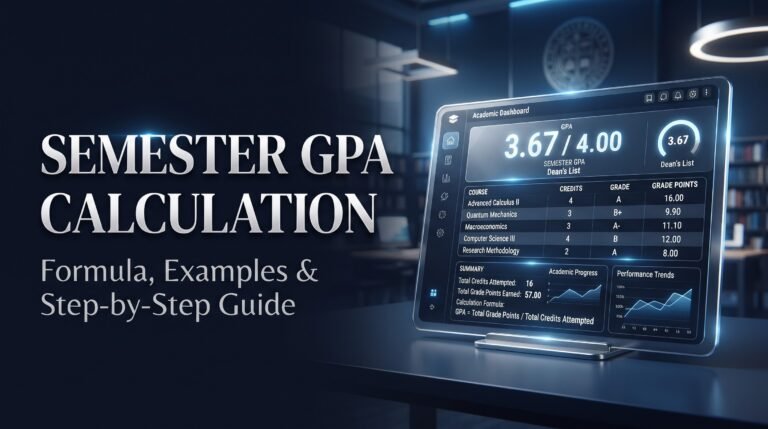
Semester GPA measures academic performance during one particular semester.
The formula is:
Semester GPA = Semester Quality Points ÷ Semester Credit Hours
For example, if a student earns 45 quality points across 15 credit hours, the semester GPA is:
45 ÷ 15 = 3.00
Therefore, the semester GPA is 3.00.
Only eligible courses from the relevant semester are included in this calculation.
Cumulative GPA Calculation Formula
Cumulative GPA measures overall academic performance across multiple semesters.
The formula is:
Cumulative GPA = Total Quality Points from All Eligible Courses ÷ Total Eligible Credit Hours
For example, imagine a student has completed two semesters.
| Semester | Quality Points | Credit Hours |
|---|---|---|
| Semester 1 | 36 | 12 |
| Semester 2 | 42 | 14 |
| Total | 78 | 26 |
Now divide the total quality points by the total credit hours:
78 ÷ 26 = 3.00
The cumulative GPA is 3.00.
This method provides an overall view of academic performance rather than measuring only one semester.
Common Mistakes in GPA Calculation
Students can sometimes get incorrect GPA results because of small calculation mistakes.
Here are some common errors to avoid:
- Using an Incorrect Grading Scale: Always use the grade-point values provided by your institution.
- Ignoring Credit Hours: Credit hours must be included when calculating a weighted GPA.
- Adding Letter Grades Directly: Convert grades into numerical points before applying the formula.
- Using Percentage Conversion Without Verification: Percentage-to-GPA conversion methods are not universal.
- Rounding Too Early: Keep sufficient decimal places during calculations and round the final result according to institutional rules.
- Including Ineligible Courses: Some courses may be excluded or treated differently under university policies.
Checking these details can help you calculate a more accurate academic result.
Use an Online GPA Calculator
Although the GPA formula is straightforward, calculating results manually can become time-consuming when you have several courses and different credit hours.
An online GPA calculator can simplify the process by allowing you to enter your grades and credit hours to estimate your academic average.
It can be especially helpful when you want to compare possible grades, estimate your semester GPA, or monitor cumulative academic performance.
For accurate results, make sure the calculator supports the grading scale and calculation rules used by your educational institution.
Frequently Asked Questions
What is the basic GPA calculation formula?
The basic credit-weighted GPA formula is total quality points divided by total credit hours. Quality points are calculated by multiplying grade points by course credit hours.
How do I calculate GPA on a 4.0 scale?
Convert each course grade into grade points using the appropriate 4.0 grading scale. Multiply each value by its credit hours, add the quality points, and divide by total credit hours.
Can I calculate GPA without credit hours?
Yes. If your institution treats all courses equally, add the grade points and divide by the number of courses.
Is GPA calculated using percentages?
Some institutions use percentage marks to determine letter grades or grade points. However, percentage-to-GPA conversion methods differ between educational institutions.
What is the difference between semester GPA and cumulative GPA?
Semester GPA measures performance during one semester, while cumulative GPA represents academic performance across multiple eligible semesters.
Does every university use the same GPA formula?
No. Universities may use different grading scales, credit-hour systems, rounding methods, and policies for repeated or transferred courses.
Why are credit hours important in GPA calculation?
Credit hours determine the weight of each course. Courses with more credit hours generally have a greater influence on the final GPA in a credit-weighted system.
Final Thoughts
The GPA calculation formula provides a simple way to understand academic performance through grade points and credit hours.
By learning how to calculate quality points, add eligible credit hours, and apply the correct formula, students can check their academic results more confidently.
Whether you are calculating semester GPA or cumulative GPA, always follow your institution’s official grading policy.
Understanding the calculation process can help you monitor your academic progress, set realistic goals, and make better educational decisions.