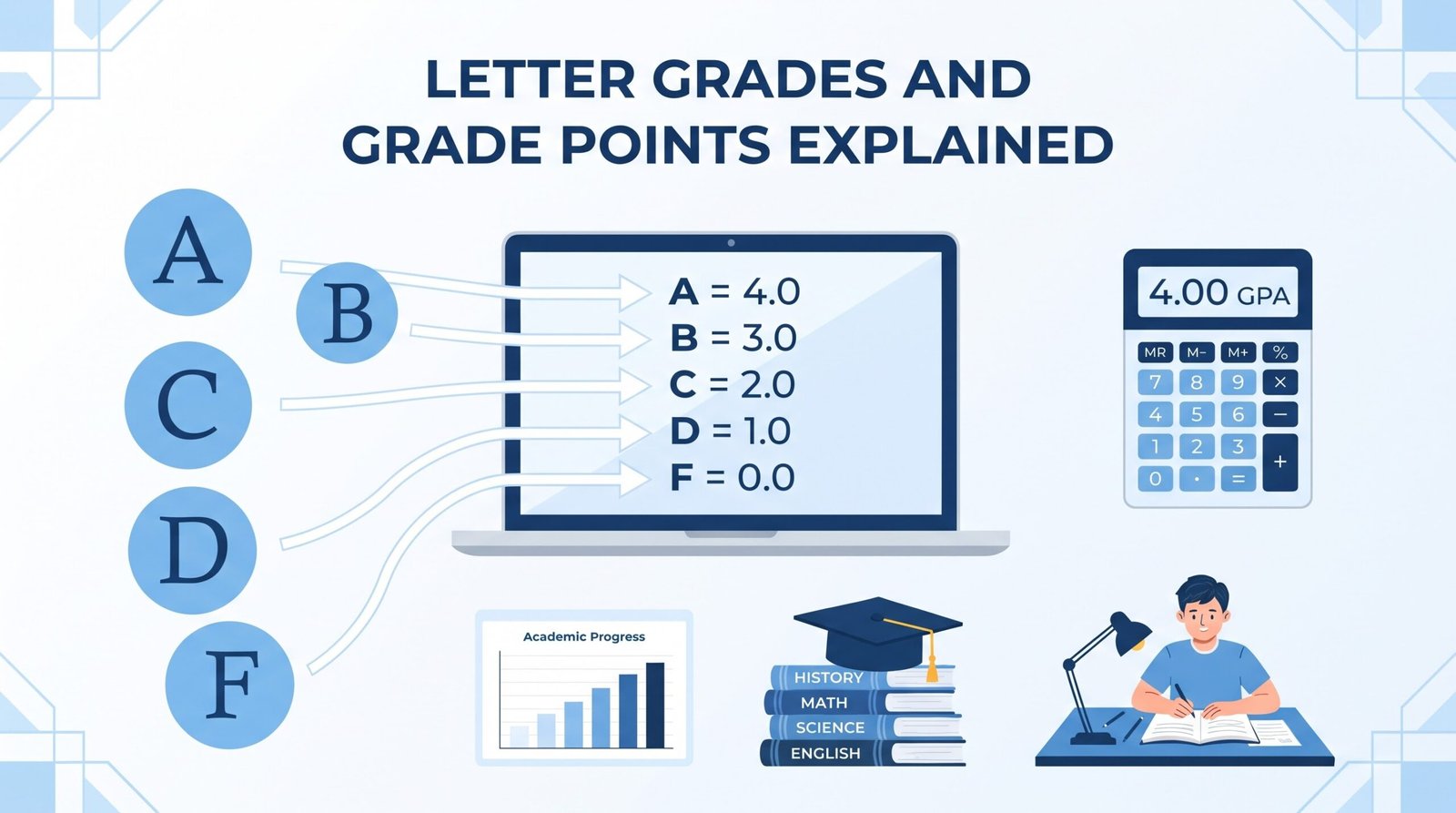
Letter grades and grade points are important parts of the academic grading system used by schools, colleges, and universities. They help educational institutions evaluate student performance and represent academic results in a clear and organized way.
Most students are familiar with letter grades such as A, B, C, D, and F. However, these letters often have numerical grade-point values that are used to calculate a student’s Grade Point Average (GPA).
Understanding how letter grades and grade points work can help students read their transcripts, calculate their GPA, track academic progress, and set realistic educational goals.
In this guide, you will learn what letter grades and grade points mean, how they are connected, and how they affect your GPA.
What Are Letter Grades?
Letter grades are symbols used to represent a student’s academic performance in a course, examination, or assignment. Instead of reporting only numerical marks, educational institutions may use letters to show how well a student has performed.
The most common letter grades include:
- A: Excellent performance
- B: Good performance
- C: Average or satisfactory performance
- D: Below-average performance or minimum passing performance
- F: Fail or unsuccessful completion
Some institutions also use plus (+) and minus (-) symbols to provide more detailed grading results. Examples include A-, B+, B-, and C+.
Letter grades make academic results easier to understand and provide a standardized way for institutions to communicate student performance.
What Are Grade Points?
Grade points are numerical values assigned to letter grades. They are commonly used by colleges and universities to calculate a student’s GPA.
For example, in a typical 4.0 grading system, an A grade may be worth 4.0 grade points, while a B grade may be worth 3.0 points.
Each course grade is converted into its corresponding grade-point value. These values are then used in the GPA calculation, often with credit-hour weighting.
Here is an illustrative example:
| Letter Grade | Grade Points |
|---|---|
| A | 4.00 |
| B | 3.00 |
| C | 2.00 |
| D | 1.00 |
| F | 0.00 |
This is a simplified example. Actual grade-point values depend on the university’s official grading policy.
Letter Grades and Grade Points Chart
Many institutions use a grading scale that includes plus and minus grades. This provides more detail than a system that uses only A, B, C, D, and F.
The following table shows an example of a 4.0 GPA grading scale:
| Letter Grade | Example Percentage Range | Grade Points |
|---|---|---|
| A | 93–100% | 4.00 |
| A- | 90–92% | 3.70 |
| B+ | 87–89% | 3.30 |
| B | 83–86% | 3.00 |
| B- | 80–82% | 2.70 |
| C+ | 77–79% | 2.30 |
| C | 73–76% | 2.00 |
| C- | 70–72% | 1.70 |
| D+ | 67–69% | 1.30 |
| D | 60–66% | 1.00 |
| F | Below 60% | 0.00 |
Important: This table is an illustrative grading scale, not a universal standard. Percentage boundaries, letter grades, and grade-point values can vary between educational institutions and academic programs.
Understanding Different Letter Grades
Each letter grade represents a different level of academic achievement. Understanding these grades can help students evaluate their results.
1. A Grade
An A grade generally represents excellent academic performance. Students who receive an A usually demonstrate a strong understanding of the course material and perform very well in examinations and assignments.
In many 4.0 systems, an A is worth 4.00 grade points.
2. B Grade
A B grade generally indicates good academic performance. It means the student understands most of the course material and has achieved a solid result.
Depending on the grading scale, a B may be worth approximately 3.00 grade points.
3. C Grade
A C grade commonly represents average or satisfactory performance. Students earning a C may have met the basic academic requirements of a course.
On many 4.0 scales, a C is worth 2.00 grade points.
4. D Grade
A D grade generally indicates below-average performance. At some institutions, it may be considered a passing grade, while certain courses or programs may require a higher result.
A D may be worth approximately 1.00 grade point in some grading systems.
5. F Grade
An F grade generally represents failure to meet the minimum academic requirements of a course.
In many 4.0 grading systems, an F is assigned 0.00 grade points. Depending on institutional policy, it may affect GPA and may require the student to repeat the course.
How Do Letter Grades Affect GPA?
Letter grades affect GPA because each grade is converted into numerical grade points. These points are then used to calculate the average academic performance across courses.
In credit-hour-based systems, courses with more credit hours usually have a greater effect on GPA.
The common formula is:
GPA = Total Quality Points ÷ Total Credit Hours
Quality points are calculated by multiplying the grade points earned in a course by its credit hours.
Example: Calculating GPA Using Letter Grades
Suppose a student completes three courses with the following results:
| Course | Letter Grade | Grade Points | Credit Hours |
|---|---|---|---|
| Mathematics | A | 4.00 | 3 |
| English | B | 3.00 | 3 |
| Science | C | 2.00 | 4 |
First, calculate the quality points for each course:
- Mathematics: 4.00 × 3 = 12
- English: 3.00 × 3 = 9
- Science: 2.00 × 4 = 8
Total quality points = 29
Total credit hours = 10
GPA = 29 ÷ 10
Final GPA = 2.90
This example shows how letter grades are converted into grade points and used to calculate GPA.
What Is the Difference Between Letter Grades and Grade Points?
Although letter grades and grade points are connected, they are not the same thing.
| Letter Grades | Grade Points |
|---|---|
| Represent academic performance using letters | Represent academic performance using numbers |
| Examples include A, B, C, D, and F | Examples include 4.0, 3.0, 2.0, and 0.0 |
| Used to report course results | Used to calculate GPA |
| May include plus and minus symbols | Assigned numerical values based on institutional rules |
In simple terms, a letter grade communicates the result, while grade points provide the numerical value needed for GPA calculations.
Why Are Grade Points Important?
Grade points play an important role in academic evaluation for several reasons.
1. GPA Calculation: Grade points are used to calculate semester GPA and cumulative GPA.
2. Academic Progress: They help students monitor their academic performance over time.
3. Scholarship Eligibility: Some scholarships require students to maintain a minimum GPA.
4. University Admissions: Colleges and universities may review GPA when evaluating applications.
5. Academic Standing: Institutions may use GPA to determine whether students meet academic requirements.
Grade points therefore help students and institutions evaluate academic achievement in a consistent way.
Frequently Asked Questions (FAQs)
1. What grade is 4.0 GPA?
On a typical 4.0 grading scale, 4.0 represents the maximum grade-point value and commonly corresponds to an A. Exact grade rules depend on the institution.
2. How many grade points is an A?
An A is commonly worth 4.00 grade points on a standard 4.0 scale, although some institutions use different values.
3. Is a B grade good?
Yes. A B generally represents good academic performance, but its exact meaning depends on the grading system.
4. How many points is a C grade?
A C is often worth 2.00 grade points on a common 4.0 scale. However, universities may assign different values.
5. Does an F grade affect GPA?
In many GPA systems, an F receives 0.00 grade points and can lower a student’s GPA. Course repetition and grade replacement policies vary by institution.
6. Are letter grades the same at every university?
No. Universities may use different letter-grade ranges, grade-point values, and passing requirements.
Conclusion
Letter grades and grade points are essential parts of many educational grading systems. Letter grades such as A, B, C, D, and F communicate a student’s performance, while grade points convert those results into numerical values used for GPA calculations.
Understanding the relationship between letter grades and grade points makes it easier to interpret academic transcripts, calculate GPA, and monitor educational progress.
Remember that grading scales are not identical everywhere. Always check your institution’s official grading policy to understand the exact meaning and numerical value of each letter grade.