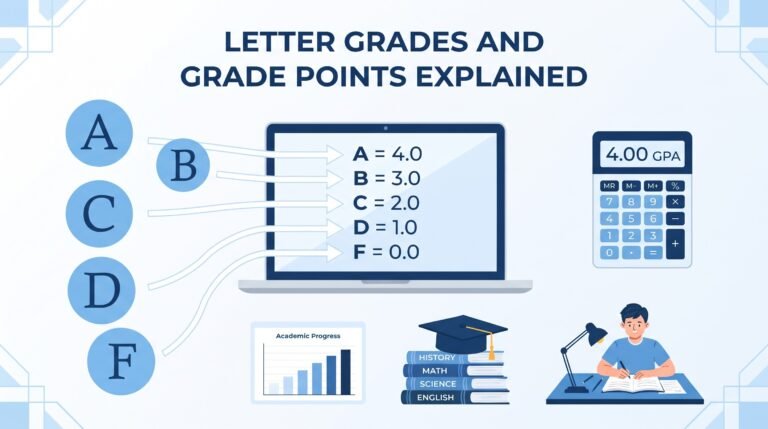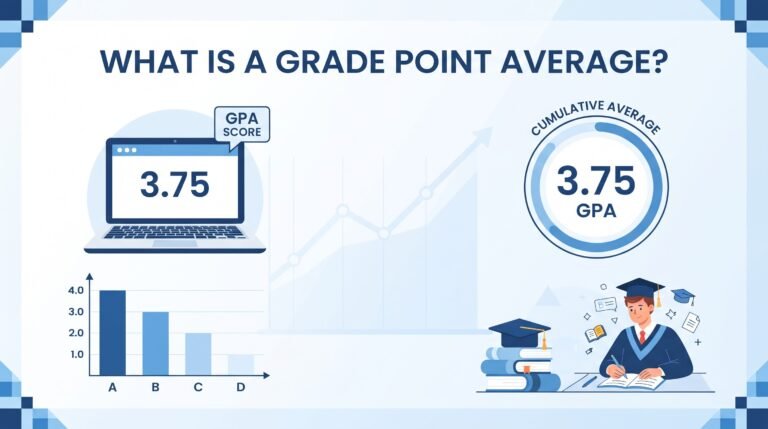
GPA and percentage are two common grading systems used by schools, colleges, and universities to measure students’ academic performance. GPA represents academic results using grade points, while percentage expresses marks as a value out of 100.
Students often need to convert GPA to percentage when applying for university admission, scholarships, international education programs, or employment opportunities. Understanding how GPA to percentage conversion works can help students interpret their academic results and prepare the correct information for applications.
However, it is important to understand that there is no single conversion formula accepted by every educational institution. Different universities use different grading scales and conversion policies. In this guide, you will learn about GPA to percentage conversion, common formulas, practical examples, and the factors that affect accurate results.
What Is GPA to Percentage Conversion?
GPA to percentage conversion is the process of expressing a student’s Grade Point Average as a percentage.
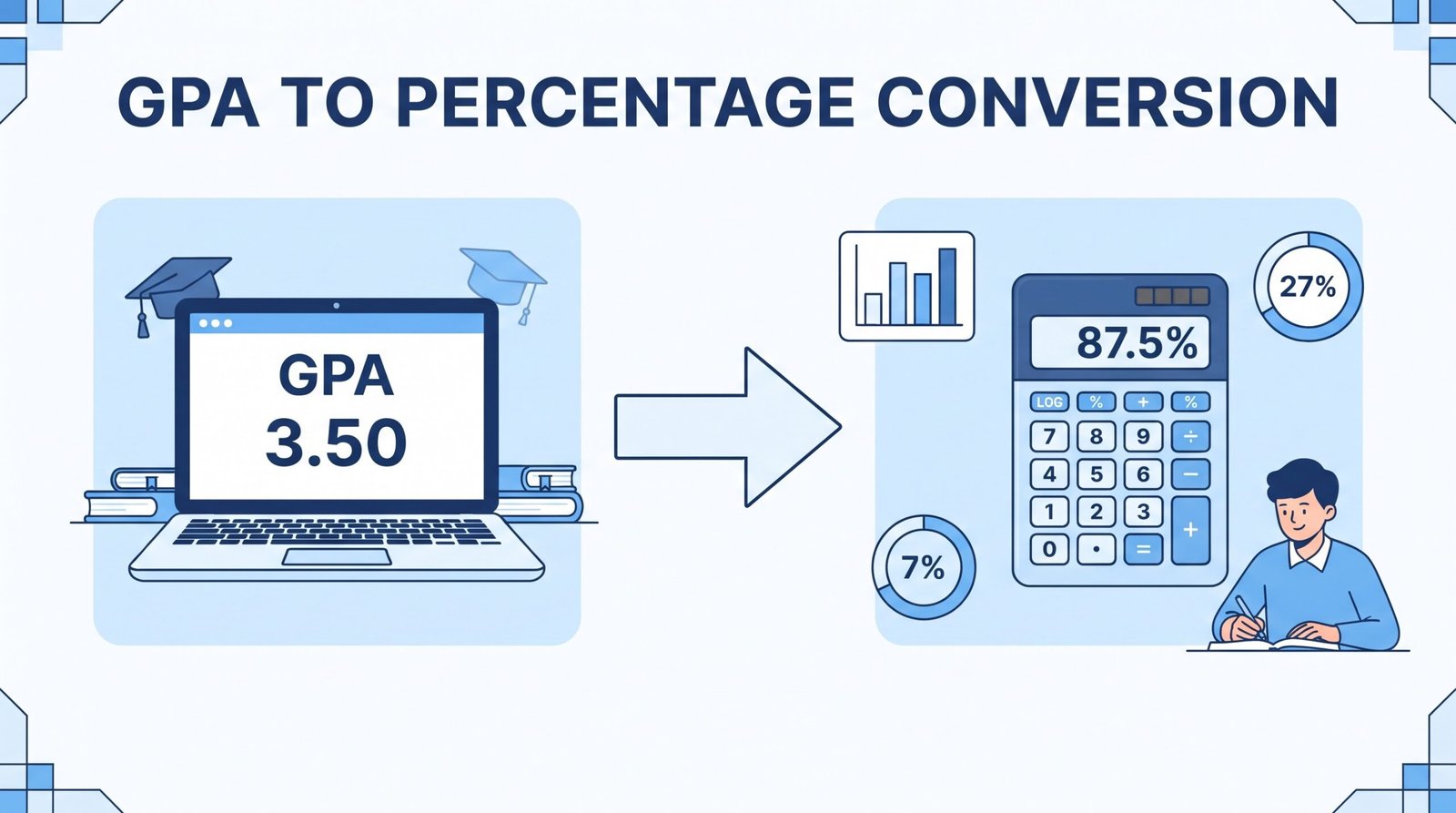
For example, a student may have a GPA of 3.5 on a 4.0 scale. The student may want to understand how that result compares with a percentage-based grading system.
GPA and percentage represent academic performance in different ways:
- GPA: A numerical average based on grade points.
- Percentage: Marks expressed out of 100.
Although both systems measure academic achievement, their scales are not always directly equivalent. A GPA of 3.5 does not automatically represent the same percentage at every university.
GPA to Percentage Conversion Formula
The correct formula depends on the grading policy of the institution that issued the GPA.
Some universities provide an official conversion formula, while others publish a GPA-to-percentage conversion table.
One simple proportional calculation sometimes used for illustration is:
Percentage = (GPA ÷ Maximum GPA) × 100
For example, if a student has a GPA of 3.2 on a 4.0 scale:
Percentage = (3.2 ÷ 4.0) × 100
Percentage = 0.8 × 100
Percentage = 80%
This is a mathematical proportional calculation, not a universally accepted academic conversion. It should only be used as an official conversion if the relevant institution specifically approves this method.
How to Convert GPA to Percentage on a 4.0 Scale
Many universities use a 4.0 GPA scale. Students studying under this system may need to convert their GPA into a percentage for applications or academic comparisons.
Consider the following illustrative calculations using the proportional formula:
| GPA | Maximum GPA | Proportional Result |
|---|---|---|
| 4.00 | 4.00 | 100% |
| 3.80 | 4.00 | 95% |
| 3.50 | 4.00 | 87.5% |
| 3.20 | 4.00 | 80% |
| 3.00 | 4.00 | 75% |
| 2.80 | 4.00 | 70% |
| 2.50 | 4.00 | 62.5% |
| 2.00 | 4.00 | 50% |
Important: These figures show proportional mathematical results only. They are not official percentage equivalents for every 4.0 GPA system. Universities may use different grade boundaries, percentages, or conversion tables.
How to Convert GPA to Percentage on a 5.0 Scale
Some educational institutions use a 5.0 GPA scale instead of a 4.0 scale.
If an institution specifically uses a proportional conversion, the calculation is:
Percentage = (GPA ÷ 5.0) × 100
For example, suppose a student earns a GPA of 4.2 out of 5.0.
Percentage = (4.2 ÷ 5.0) × 100
Percentage = 0.84 × 100
Percentage = 84%
Again, this result is valid as an institutional conversion only when the university uses this proportional method. A 5.0 GPA scale may also include weighted courses or other grading rules.
GPA to Percentage Conversion Examples
Here are some practical examples to help explain the calculation.
Example 1: Convert 3.6 GPA to Percentage
Suppose a student has a GPA of 3.6 on a 4.0 scale, and their institution uses the proportional formula.
Step 1: Identify the GPA.
GPA = 3.6
Step 2: Identify the maximum GPA.
Maximum GPA = 4.0
Step 3: Apply the formula.
Percentage = (3.6 ÷ 4.0) × 100
Percentage = 0.9 × 100
Answer = 90%
This is the proportional result, not necessarily the university’s official percentage equivalent.
Example 2: Convert 3.0 GPA to Percentage
Suppose a student has a GPA of 3.0 out of 4.0.
Percentage = (3.0 ÷ 4.0) × 100
Percentage = 0.75 × 100
Answer = 75%
Example 3: Convert 4.5 GPA to Percentage
Suppose a student has a GPA of 4.5 out of 5.0.
Percentage = (4.5 ÷ 5.0) × 100
Percentage = 0.9 × 100
Answer = 90%
These examples demonstrate how proportional conversion works when the maximum GPA is known.
Why Does GPA to Percentage Conversion Differ Between Universities?
GPA conversion can vary because educational institutions do not always use identical grading systems.
Some important factors include:
1. Different Grading Scales: Universities may use 4.0, 5.0, 10.0, or other GPA scales.
2. Grade Boundaries: The percentage range assigned to an A, B, or C grade can differ between institutions.
3. Credit Hours: Some GPA systems calculate results using credit-hour weighting, while others may follow different academic rules.
4. Institutional Policies: Universities may publish their own official conversion formulas or tables.
5. Country Differences: Educational systems in different countries may use different methods for calculating and reporting academic results.
For these reasons, students should check their university’s official grading policy before submitting a converted percentage.
Is a 3.5 GPA Equal to 87.5%?
Not necessarily. If you use a proportional formula on a 4.0 scale, 3.5 GPA produces 87.5%.
However, this does not mean every university considers a 3.5 GPA equivalent to 87.5%. Some institutions use grade-based conversion tables or other official methods.
If you need a percentage for admission, a scholarship, or an international application, use the conversion method required by the receiving institution.
Why Is GPA to Percentage Conversion Important?
GPA to percentage conversion can be useful in several academic and professional situations.
- University Admissions: Some institutions request academic results in percentage format.
- Scholarship Applications: Scholarship providers may specify minimum percentage requirements.
- International Education: Students applying abroad may need their grades evaluated using another country’s academic system.
- Employment Applications: Some employers request percentage-based academic results.
- Academic Comparisons: Percentage results can help students understand academic performance when comparing different grading formats.
Always provide the original GPA along with an officially converted percentage when the application process requires it.
Frequently Asked Questions (FAQs)
1. How do I convert GPA to percentage?
First, check your university’s official conversion policy. If it uses the proportional formula, divide your GPA by the maximum GPA and multiply by 100.
2. What is 3.5 GPA in percentage?
Using the proportional formula on a 4.0 scale, 3.5 GPA equals 87.5%. The official equivalent may differ depending on the institution.
3. Is a 4.0 GPA equal to 100%?
Not necessarily. A 4.0 GPA represents the maximum value on a 4.0 scale, but its official percentage equivalent depends on the university’s grading policy.
4. Can I convert GPA to percentage without knowing the GPA scale?
No, you need to know the maximum GPA and the institution’s conversion policy to calculate a meaningful equivalent.
5. Is GPA to percentage conversion the same everywhere?
No. Different institutions use different grading scales, formulas, and conversion tables.
6. Which GPA conversion method should I use for university admission?
Use the method specified by the university or admission authority you are applying to. If no conversion method is provided, contact the admissions office for guidance.
Conclusion
GPA to percentage conversion helps students understand their academic results in a percentage-based format. The proportional formula provides a simple mathematical calculation, but it is not a universal academic standard.
Every university may have its own grading scale and conversion policy. Before using a converted percentage for admission, scholarships, or employment, always verify the official requirements.
Understanding the difference between GPA and percentage will help you present your academic achievements more accurately and avoid mistakes during applications.