Understanding your academic performance is important, especially when you want to know how well you have performed during a particular semester. One of the easiest ways to measure your academic results is through Semester GPA.
Semester GPA represents the average grade points a student earns in all eligible courses during one academic semester. It helps students evaluate their performance, identify areas that need improvement, and monitor their academic progress.
Whether you are studying at a college or university, knowing how to calculate semester GPA can make it easier to understand your grades and plan your future studies.
In this guide, you will learn what semester GPA means, how the calculation works, which formula to use, and how to calculate your result with practical examples.
What Is Semester GPA?
Semester GPA stands for Semester Grade Point Average. It measures a student’s academic performance during a single semester rather than their entire educational program.
Most colleges and universities assign grade points to individual course grades. These points are combined using the credit hours of each course to calculate the semester GPA.
For example, if a student completes five courses during one semester, the grade points earned in those courses are used to determine the final semester average.
Unlike cumulative GPA, which includes results from multiple semesters, semester GPA focuses only on the courses included in the current semester’s calculation.
Semester GPA Calculation Formula
The standard method of calculating semester GPA is based on grade points and credit hours.
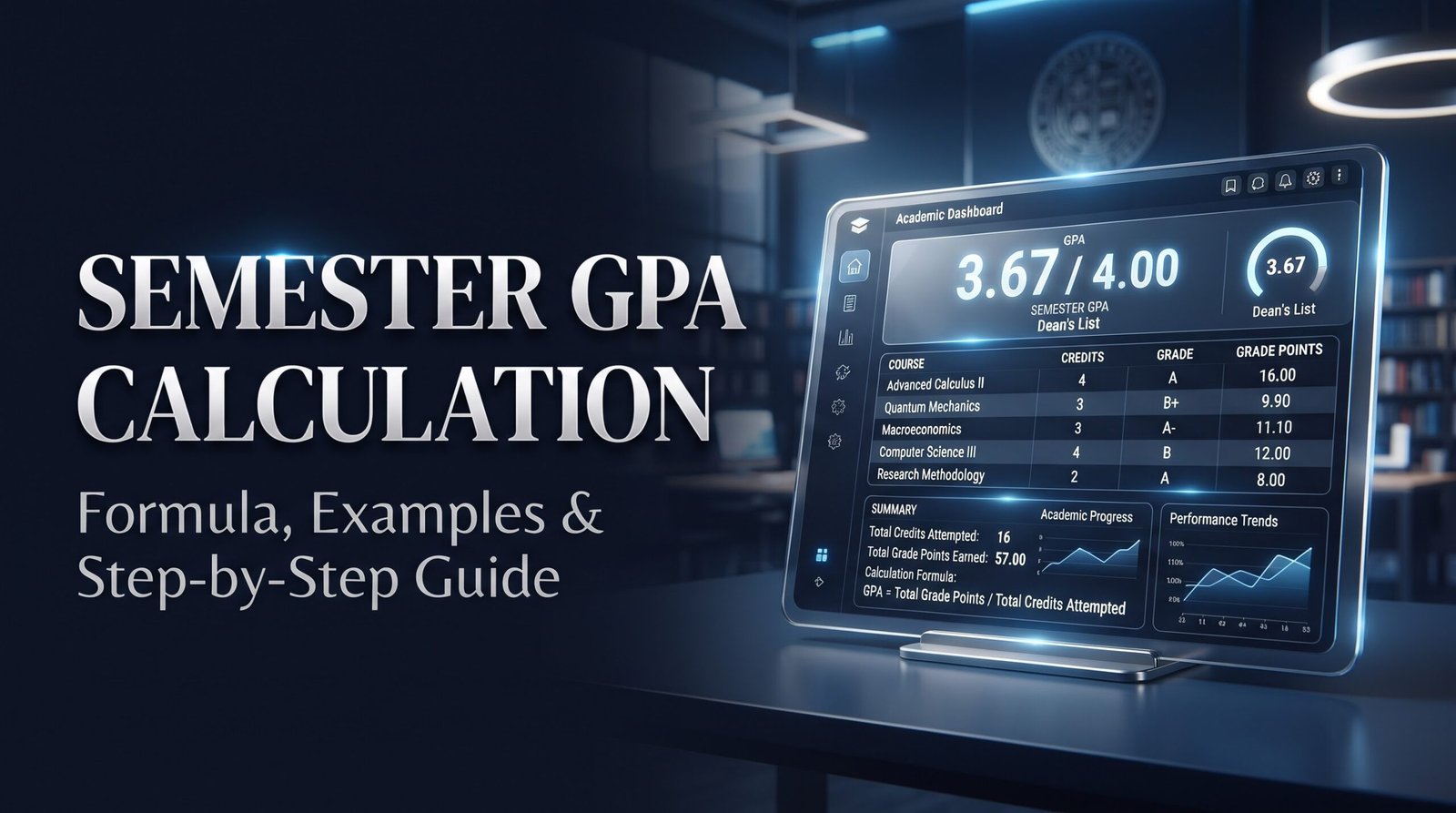
Semester GPA = Total Quality Points ÷ Total Semester Credit Hours
To calculate quality points, multiply the grade points earned in each course by its credit hours.
The complete formula is:
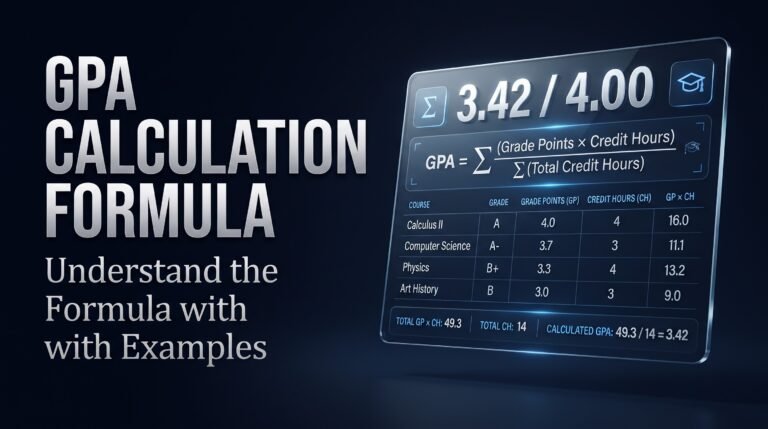
Semester GPA = Σ (Grade Points × Credit Hours) ÷ Total Credit Hours
Here is what each term means:
- Grade Points: The numerical value assigned to your course grade.
- Credit Hours: The academic weight assigned to a particular course.
- Quality Points: Grade points multiplied by the course credit hours.
- Total Credit Hours: The combined credit hours of all eligible courses in the semester.
This formula is commonly used by institutions that follow a credit-weighted GPA system.
How to Calculate Semester GPA Step by Step
Calculating your semester GPA becomes easier when you follow a consistent process.
Step 1: Collect Your Course Grades
Start by listing all the courses you completed during the semester.
Make sure you use the final grades recorded by your educational institution.
Step 2: Convert Grades Into Grade Points
Every course grade must be converted into its corresponding grade-point value.
For example, a common 4.0 grading scale may assign 4.0 points to an A, 3.0 to a B, and 2.0 to a C.
However, grading systems differ between institutions, so always check your official grading policy.
Step 3: Check the Credit Hours
Find the credit hours assigned to every course.
A course with four credit hours may have a greater influence on your semester GPA than a course with only two credit hours.
Step 4: Calculate Quality Points
Multiply the grade points of each course by its credit hours.
For example:
3.0 grade points × 3 credit hours = 9 quality points.
Repeat this calculation for every eligible course.
Step 5: Add All Quality Points
Combine the quality points earned in all courses to find the total quality points for the semester.
Step 6: Divide by Total Credit Hours
Add all the eligible course credit hours and divide the total quality points by the total credit hours.
The final result is your semester GPA.
Semester GPA Calculation Example
Let’s understand the calculation through a practical university example.
Suppose a student completes five courses during one semester. Their grades and credit hours are shown below.
| Subject | Grade | Grade Points | Credit Hours |
|---|---|---|---|
| Mathematics | A | 4.0 | 3 |
| English | B | 3.0 | 3 |
| Computer Science | A | 4.0 | 4 |
| Physics | B | 3.0 | 3 |
| History | C | 2.0 | 2 |
| Total | — | — | 15 |
Now calculate the quality points for each course:
- Mathematics: 4.0 × 3 = 12
- English: 3.0 × 3 = 9
- Computer Science: 4.0 × 4 = 16
- Physics: 3.0 × 3 = 9
- History: 2.0 × 2 = 4
Add the quality points:
12 + 9 + 16 + 9 + 4 = 50
The total credit hours are 15.
Now apply the semester GPA formula:
50 ÷ 15 = 3.33
Final Semester GPA = 3.33 out of 4.00
This means the student achieved a semester GPA of approximately 3.33 on the example grading scale.
Common 4.0 GPA Grading Scale
A grading scale helps students understand how letter grades are converted into numerical grade points.
The following table provides a simplified example of a 4.0 grading system.
| Letter Grade | Grade Points | Performance |
|---|---|---|
| A | 4.0 | Excellent |
| B | 3.0 | Good |
| C | 2.0 | Average |
| D | 1.0 | Below Average |
| F | 0.0 | Fail |
Some institutions use additional grades such as A-, B+, and C-. Their grade-point values may be different.
Always use your university’s official grading scale for an accurate semester GPA calculation.
What Is the Difference Between Semester GPA and Cumulative GPA?
Semester GPA and cumulative GPA are related, but they measure different periods of academic performance.
Semester GPA focuses on one semester, while cumulative GPA represents performance across multiple semesters.
| Feature | Semester GPA | Cumulative GPA |
|---|---|---|
| Measurement | One semester | Multiple semesters |
| Calculation | Current semester courses | All eligible courses |
| Purpose | Track recent performance | Track overall performance |
| Changes | After each semester | As new results are included |
| Academic Scope | Short-term | Long-term |
For example, a student may achieve a 3.70 semester GPA in the current semester but have a cumulative GPA of 3.20 because of lower grades in previous semesters.
How Can You Improve Your Semester GPA?
Improving your semester GPA requires consistent study habits and proper academic planning.
Here are some useful ways to improve your academic results:
1. Follow a Study Schedule: Organize your daily study hours and give enough time to every subject.
2. Focus on Difficult Courses: Identify subjects where you are struggling and spend additional time understanding important concepts.
3. Complete Assignments on Time: Regular assignments and coursework can contribute to your final grades.
4. Prepare Before Examinations: Start preparing early instead of depending entirely on last-minute studying.
5. Monitor Your Grades: Keep track of your academic results throughout the semester to understand where improvement is needed.
6. Ask for Academic Guidance: Teachers and academic advisors can help you understand difficult topics and improve your performance.
Small improvements across several courses can make a meaningful difference to your final semester GPA.
Use an Online Semester GPA Calculator
Manually calculating semester GPA is useful for understanding the process, but it can become time-consuming when you have several courses.
An online semester GPA calculator provides a convenient way to estimate your academic results.
You can enter your course grades, select the corresponding grade points, and add credit hours to calculate your GPA.
Using an online GPA calculator can help reduce calculation errors and save time when checking different academic results.
For the most accurate result, select the grading scale and calculation method used by your educational institution.
Frequently Asked Questions
How do I calculate my semester GPA?
Multiply each course’s grade points by its credit hours, add all quality points, and divide the result by the total semester credit hours.
Is semester GPA calculated every semester?
Yes. Semester GPA is calculated separately for each academic semester using the eligible courses completed during that period.
Does credit hour affect semester GPA?
Yes. In a credit-weighted GPA system, courses with more credit hours have a greater influence on the final result.
Is a 3.5 semester GPA good?
A 3.5 GPA is generally considered a strong academic result on a traditional 4.0 scale. However, academic classifications vary between institutions.
Can semester GPA be higher than cumulative GPA?
Yes. A student can achieve a higher semester GPA than their cumulative GPA if their recent academic performance is better than their previous results.
What is the difference between semester GPA and annual GPA?
Semester GPA measures performance during one semester, while annual GPA may represent academic performance across an entire academic year. The exact calculation depends on the institution.
Can I calculate semester GPA without credit hours?
Yes, if your institution uses an equal-weight system where every course has the same value. In that case, add the grade points and divide by the number of courses.
Final Thoughts
Semester GPA is a useful way to measure academic performance during a particular study period. Understanding its calculation can help students evaluate their grades, monitor progress, and identify opportunities for improvement.
The basic calculation involves converting course grades into grade points, multiplying those points by credit hours, adding the quality points, and dividing by the total credit hours.
Whether you calculate your GPA manually or use an online calculator, always follow your institution’s official grading system.
Keeping track of your semester GPA throughout your academic journey can help you make better decisions and work toward your educational goals.