GPA is one of the most important academic measurements used by schools, colleges, and universities around the world. Whether you are a high school student, a college learner, or someone planning to study abroad, understanding GPA can help you track your academic progress and set realistic educational goals.
But what exactly is GPA, how does it work, and why do educational institutions use it?
GPA stands for Grade Point Average. It is a numerical value that represents a student’s overall academic performance. Instead of looking at individual grades separately, GPA combines the results of multiple subjects into one average score.
In this guide, you will learn what GPA means, how it is calculated, how grading scales work, and how students can understand their academic results.
What Does GPA Stand For?
GPA stands for Grade Point Average. It is a standard academic measurement used to summarize a student’s performance across different courses or subjects.
Most educational institutions assign numerical points to letter grades or percentage marks. These points are then used to calculate an average academic score.
For example, a student who receives high grades in most subjects will generally have a higher GPA than someone who receives lower grades.
GPA makes it easier for teachers, universities, and academic institutions to evaluate student performance using a common numerical system.
Although GPA is widely used in countries such as the United States and Canada, grading systems can vary between educational institutions and countries.
How Does GPA Work?
GPA works by converting your academic grades into numerical grade points. Each subject contributes to your overall academic performance.
In many institutions, grades are assigned points on a 4.0 scale. However, some schools use 5.0 scales, percentage-based systems, or other grading methods.
For example, a common unweighted grading scale looks like this:
| Letter Grade | Grade Points | General Meaning |
|---|---|---|
| A | 4.0 | Excellent |
| B | 3.0 | Good |
| C | 2.0 | Average |
| D | 1.0 | Below Average |
| F | 0.0 | Fail |
This is a simplified example. Some institutions use plus and minus grades, such as A-, B+, or C-, with different numerical values.
The main purpose of this system is to convert different subject results into a consistent numerical format.
How Is GPA Calculated?
GPA is generally calculated by adding the grade points earned in each course and dividing the total by the number of courses.
However, many colleges and universities use credit hours to calculate GPA. In a credit-weighted system, subjects with more credit hours have a greater influence on the final result.
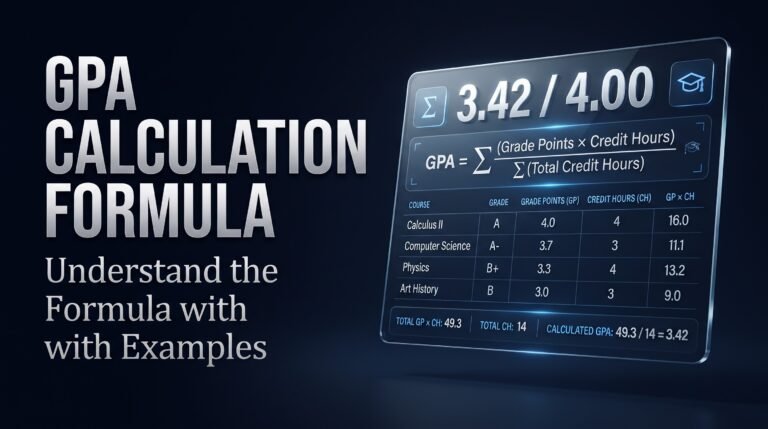
The standard credit-weighted GPA formula is:
GPA = Total Grade Points Earned ÷ Total Credit Hours
To understand this calculation, consider the following example.
Imagine a student takes three courses:
| Subject | Grade Points | Credit Hours |
|---|---|---|
| Mathematics | 4.0 | 3 |
| English | 3.0 | 3 |
| Science | 3.5 | 2 |
| Total | — | 8 |
First, multiply each subject’s grade points by its credit hours.
- Mathematics: 4.0 × 3 = 12
- English: 3.0 × 3 = 9
- Science: 3.5 × 2 = 7
The total quality points are:
12 + 9 + 7 = 28
Now divide the total quality points by the total credit hours:
28 ÷ 8 = 3.50
Therefore, the student’s GPA is 3.50 out of 4.00.
This example demonstrates why credit hours matter when calculating GPA.
What Is a Good GPA?
A good GPA depends on your educational institution, academic program, and future goals. Some universities have higher admission requirements than others, while certain scholarships require students to maintain a specific GPA.
On a commonly used 4.0 scale, the following table provides a general interpretation:
| GPA | General Academic Standing |
|---|---|
| 4.0 | Outstanding |
| 3.7–3.9 | Excellent |
| 3.3–3.6 | Very Good |
| 3.0–3.2 | Good |
| 2.5–2.9 | Average |
| 2.0–2.4 | Below Average |
| Below 2.0 | May Require Improvement |
These descriptions are general guidelines, not universal academic standards. Actual grade classifications differ between institutions.
For example, a GPA of 3.5 may be considered competitive for many academic opportunities, but admission decisions also depend on the university, program, application requirements, and other qualifications.
What Are the Different Types of GPA?
Students may come across different GPA measurements during their academic journey. Each type provides information about performance over a particular period or across multiple courses.
1. Semester GPA
Semester GPA measures a student’s academic performance during one semester.
It is calculated using the grades and credit hours earned in courses completed during that semester.
For example, if a student completes five subjects in the fall semester, the grades from those subjects are used to calculate the semester GPA.
2. Cumulative GPA
Cumulative GPA represents a student’s overall academic performance across multiple semesters.
It includes previously completed courses according to the institution’s GPA calculation rules.
Unlike semester GPA, cumulative GPA provides a broader picture of academic progress over time.
3. Weighted GPA
Weighted GPA considers the difficulty level of certain courses.
Some educational institutions give additional grade points for advanced classes, honors courses, or specific challenging subjects.
As a result, a weighted GPA may be higher than an unweighted GPA.
4. Unweighted GPA
Unweighted GPA measures academic performance without giving extra points for advanced or more difficult courses.
A traditional 4.0 grading scale is commonly used for unweighted GPA calculations.
What Is the Difference Between GPA and Percentage?
GPA and percentage are two different ways of measuring academic performance.
A percentage represents the marks a student earns out of the total possible marks. GPA converts academic results into a numerical grade-point system.
For example, a student may receive 85% in an examination, while another institution may report academic performance using a GPA scale.
However, there is no single conversion formula that applies to every school or university.
| Feature | GPA | Percentage |
|---|---|---|
| Measurement | Grade points | Marks out of 100 |
| Common Format | 4.0 or 5.0 scale | 0–100% |
| Calculation | Average of grade points | Obtained marks ÷ Total marks × 100 |
| Common Use | Academic evaluation | Examination results |
| Grading Method | Numerical point system | Percentage-based system |
Students planning to apply to international universities should always check the institution’s official grade conversion requirements rather than assuming that a particular percentage automatically equals a specific GPA.
Why Is GPA Important for Students?
GPA plays an important role in many academic decisions. Educational institutions use it to understand a student’s academic performance and consistency.
Here are some common reasons why GPA matters:
University Admissions: Many universities consider GPA when reviewing applications. A strong academic record may improve a student’s competitiveness for admission.
Scholarship Opportunities: Some scholarships require applicants to maintain a minimum GPA to qualify.
Academic Progress: GPA helps students understand their performance and identify subjects where improvement may be necessary.
Graduate School Applications: Students applying for postgraduate programs may need to meet specific GPA requirements.
Academic Recognition: Certain institutions use GPA to determine honors, distinctions, or academic awards.
It is important to remember that GPA is not the only factor in academic success. Personal projects, practical experience, entrance examinations, and other qualifications may also be considered.
How Can Students Improve Their GPA?
Improving GPA requires consistent effort, effective study habits, and proper academic planning.
Students can take several practical steps to improve their results:
- Create a Study Schedule: Organize your daily study time and give enough attention to every subject.
- Understand Difficult Topics: Focus on subjects where you regularly receive lower grades.
- Complete Assignments on Time: Missing assignments can negatively affect your academic performance.
- Prepare for Examinations Early: Avoid relying entirely on last-minute preparation.
- Ask for Academic Support: Contact teachers or classmates when you need help understanding a topic.
- Track Your Academic Progress: Review your grades after every semester to identify areas for improvement.
Small improvements in individual subjects can gradually make a positive difference to your overall academic record.
Frequently Asked Questions About GPA
What does GPA mean in education?
GPA means Grade Point Average. It is a numerical measurement used by educational institutions to summarize a student’s academic performance.
Is a 3.0 GPA good?
A 3.0 GPA is generally considered a good academic result on a traditional 4.0 scale. However, its value depends on the institution and the requirements of a particular academic program.
Is a 4.0 GPA the highest GPA?
On a standard unweighted 4.0 scale, 4.0 is generally the highest possible GPA. Some institutions use weighted systems that allow scores above 4.0.
Can GPA change every semester?
Yes. Your semester GPA can change after each semester. Your cumulative GPA may also increase or decrease depending on your new grades and completed credit hours.
Is GPA the same as percentage?
No. GPA is based on grade points, while percentage represents marks earned out of the total possible marks. Different institutions may use different conversion methods.
How can I calculate my GPA easily?
You can calculate GPA by dividing total quality points by total credit hours. For a quick result, you can also use an online GPA calculator that supports your institution’s grading scale.
Final Thoughts
GPA is an important academic measurement that helps students and educational institutions understand overall academic performance. It provides a convenient way to compare grades, monitor progress, and evaluate eligibility for certain educational opportunities.
Understanding how GPA works can help you make better academic decisions and identify areas where improvement is needed.
Whether you are calculating your semester GPA, checking your cumulative GPA, or preparing for university admission, knowing the correct grading system is essential.
Always remember that GPA is only one part of your educational journey. Consistent learning, practical skills, personal development, and academic dedication are equally valuable.